
Silkworm Study Reveals Evolution’s Ability to Reshape Animal Bodies
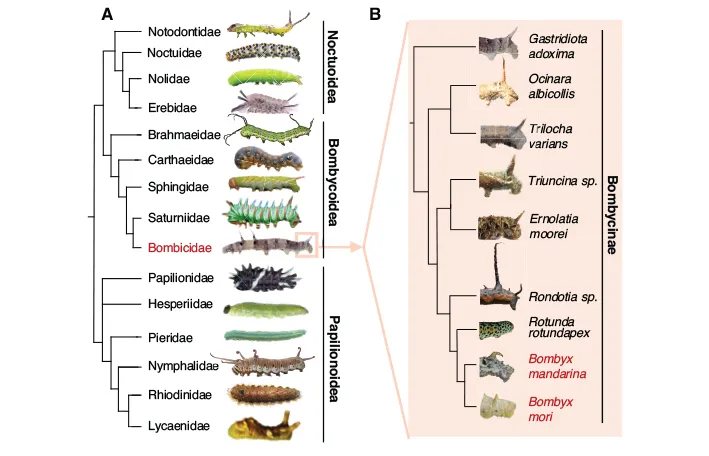
The remarkable diversity among the shapes of animal bodies raises a fundamental question in evolutionary biology: how do changes in the physical forms of animals arise? Over time, how do toes become hooves, or a long tail become short? At the genetic level, does this diversity stem from large changes to a few genes, or the gradual accumulation of small changes across many genes? Or, because genes generate proteins, do the key differences lie in the structure of those proteins, or perhaps in how, where, and when those proteins appear? One long-standing hypothesis proposes that changes to certain master regulator genes – genes at the top of a hierarchy that tells other genes what to do - drive the evolution of animal forms. Yet despite the appeal of this idea, concrete examples directly linking such changes to differences in complex body structures remain surprisingly rare.
A new study led by graduate student Kenta Tomihara at the University of Tokyo and postdoctoral researcher Ana Pinharanda in the Andolfatto Lab at Columbia University explores these questions by investigating a striking physical difference between two closely related silkworm species: the domesticated silk moth Bombyx mori and its wild relative Bombyx mandarina. Both silkworm species have a horn-like structure at their rear end known as the caudal horn, which varies greatly in shape and size across members of the silkworm family. Little is known about its function, but in some species, it may play a role in camouflage or sensory perception. Some silkworms have also been observed moving their caudal horn when disturbed, and other types of caterpillars with similar horn-like structures rapidly beat them when approached by parasitic insects, suggesting a possible defensive role. Notably, B. mori has a much smaller horn than its wild relative, despite having been domesticated about four to ten thousand years ago. Being a relatively short time in terms of evolution, this raises a key question: how can such visible changes arise with such little time for genetic change?
Studying these two silkworm species offers another advantage: because they are so closely related, they can be bred to produce fertile hybrids. When the researchers bred B. mori and B. mandarina to create such hybrids, they saw a continuous range of intermediate horn lengths among the offspring. They used quantitative trait locus (QTL) analyses to map which regions of the genome were correlated to the longer and shorter horns across this spectrum. This analysis pointed to a region of the genome containing a cluster of Wnt genes, master developmental regulators that are highly conserved across animals. To investigate further, the researchers used RNA sequencing and polymerase chain reaction (PCR) to characterize gene expression across different segments of the caterpillar, including the horn. These approaches revealed two Wnt genes, Wnt1 and Wnt6, that were more highly expressed in the longer horns of wild B. mandarina than in the shorter horns of domesticated B. mori.
Surprisingly, the Wnt proteins themselves are identical in these two species. This suggested that differences in horn length did not arise due to differences in the proteins themselves but were instead likely to arise from how they are temporally and spatially regulated. All genes are surrounded by non-coding DNA, which helps control when and where genes are expressed. These nearby regulatory regions, called cis-regulatory elements, contain sites where gene expression machinery can be enhanced or repressed. The researchers found that Wnt1 and Wnt6 were expressed both earlier and at higher levels in the wild, larger-horned silkworm than in its domesticated, smaller horned relative.
To determine whether this difference was due to surrounding regulatory regions of non-coding DNA or to broader cellular differences, they looked at the activity of genes in hybrid silkworms, which carry both wild and domesticated versions of Wnt1 and Wnt6. In these hybrid silkworms, where both versions of the genes exist in the same cellular context, the researchers found that the wild version of Wnt1 and Wnt6 are expressed at higher levels. Given the same cellular environments, this difference indicates that cis-regulatory elements that help control when and where genes are expressed are responsible for the evolutionary change in horn shape.
Lastly, the researchers used CRISPR/Cas9 gene editing to see what would happen when they rendered these genes non-functional. Indeed, they observed that knocking out Wnt1 or Wnt6 reduced caudal horn length, with Wnt1 showing the largest effect. Therefore, the authors conclude that Wnt1 and Wnt6 regulate horn growth during development, as well as the difference in horn length between the two species, with the expression level of Wnt1 being the primary driver.
This study highlights how evolution can modify body form without altering the actual proteins that genes produce. Wnt1 and Wnt6 are not horn-specific genes, and in fact they play diverse roles in a variety of contexts throughout development. If mutations to each of these genes were used to modify horn length, there would likely be detrimental impacts to the organism at other stages of development. Therefore, modifying surrounding non-coding DNA to control the timing and dosage of gene expression is a subtle and safe way to regulate the function of a gene without changing anything about what the gene itself produces.
The study also highlights how changes to a relatively small number of genes can result in dramatic differences in body shapes over short evolutionary timescales. This principle underlies why species with highly similar genomes may look dramatically different. It is becoming clear now that in many cases, evolution functions not by inventing new genes, but by reusing old ones in new ways.