
Not So Different, You and I: Secrets of Human Brain Evolution Uncovered in the Salamander
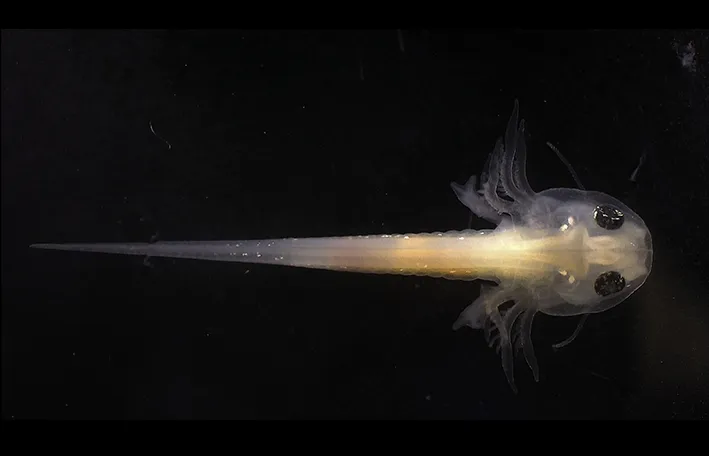
Your cerebral cortex, the folded outer layer of the brain involved in thought, perception, and personality, is considered an evolutionary masterpiece. But according to new research, the mammalian cortex may be less of a revolutionary invention and more of an elaborate renovation.
A new study published in Current Biology by Dr. Maria Tosches’ lab argues that the dramatically expanded and diversified mammalian cortex did not emerge from entirely new kinds of brain cells, as previously believed. Instead, evolution appears to have repurposed ancient cellular building blocks, rewriting their genetic programs over hundreds of millions of years to create increasingly complex brains.
This story centers on a cell type that, for over a century, seemed to belong firmly to mammals alone. In the late 1800s, pioneering scientists at the advent of modern neuroscience, Santiago Ramón y Cajal and Gustaf Retzius, independently described a striking neuron in the developing brains of mammals spanning from rabbits to humans. The cells, now known as the Cajal-Retzius cells, became closely associated with mammal-specific features of cortical development.
For his thesis work, Biological Sciences PhD student Eli Gumnit set out to test whether the assumption that Cajal-Retzius cells are uniquely mammalian was actually true by searching for the cells across a broad range of vertebrate species.
To find these elusive cells across species, Gumnit and his collaborators turned to a powerful modern technique called single-cell transcriptomics. Rather than identifying cells by shape alone, the method allows researchers to read out which genes individual cells are actively using, effectively giving each cell its own molecular fingerprint and enabling precise classification. By comparing the mouse Cajal-Retzius genetic fingerprint to brain transcriptomes from species ranging from chickens to salamanders to fish, the team sought to determine whether functionally different brain cells were in fact deeply related.
The team generated and analyzed vast, complex datasets that were often difficult to interpret. As Gumnit described it, working through the data often felt like solving a mystery, sifting through mountains of evidence until the key clues finally emerged and everything clicked into place. In the end, core genetic regulators that define mammalian Cajal-Retzius cells emerged in cell populations across species, suggesting that cells with a Cajal-Retzius-like molecular identity exist in non-mammals as well. Identifying this conserved set of genetic regulators reveals a deep evolutionary continuity in how Cajal-Retzius cells are built.
Not only was this evolutionary continuity identified computationally, the team also returned to the tissue itself to confirm the continuity visually. Using specialized imaging techniques, they mapped where key genetic regulators were expressed across species directly within the intact developing brain. The resulting images revealed strikingly conserved spatial patterns of gene expression across species.
Yet the picture that emerged was not one of complete uniformity. The researchers found that only the terrestrial vertebrate species, not fish, showed robust expression of Reelin, a protein that plays a central role in the unique development and layering of mammalian cortex. This suggests that while Cajal-Retzius cells existed earlier in vertebrate evolution, some of their most critical functional properties were refined later in evolutionary time.
In addition, the analysis showed that Cajal-Retzius cells are not an isolated cell type, but part of a broader, evolutionarily related family of neurons. For example, they share a striking molecular similarity with a type of neuron found in the olfactory bulb, the brain region responsible for smell. This relationship suggests a shared ancestral neuronal population that later diverged into distinct roles in cortical and olfactory circuits.
The apparent divergence of Cajal-Retzius and olfactory bulb neurons from a shared ancestral population fits with a broader idea in evolutionary biology: that cell types can act like semi-independent building blocks that can be reused and modified over time. In this framework, duplication creates redundancy, meaning the same basic cell type exists in more than one copy. One copy can then maintain its original role while the other is free to change, gradually taking on new functions without disrupting the baseline system.
As Gumnit put it, “cell types are kind of evolutionary modules… if they duplicate, you have redundancy, and one can start doing its own thing.” His research suggests that Cajal-Retzius cells and their olfactory-related counterparts may represent exactly this kind of split, two diverging outcomes of a shared ancestral program. “It was satisfying,” he said, “to see these abstract concepts actually validated in a real experiment.”
Taken together, these findings suggest a different way of thinking about how complex brains evolve. Rather than relying on the invention of entirely new cell types, the mammalian cortex seems to have emerged through the gradual repurposing and refinement of ancient neuronal programs already present in early vertebrates. In this view, evolution does not so much build the brain from scratch as it remodels what is already there, tuning, duplicating, and specializing cellular building blocks over hundreds of millions of years. What looks like a revolutionary leap in brain complexity may, in fact, be the product of many small, cumulative renovations.