
Three Undergraduates Awarded the 2026 Bridges and Sturtevant Prize for Outstanding Research
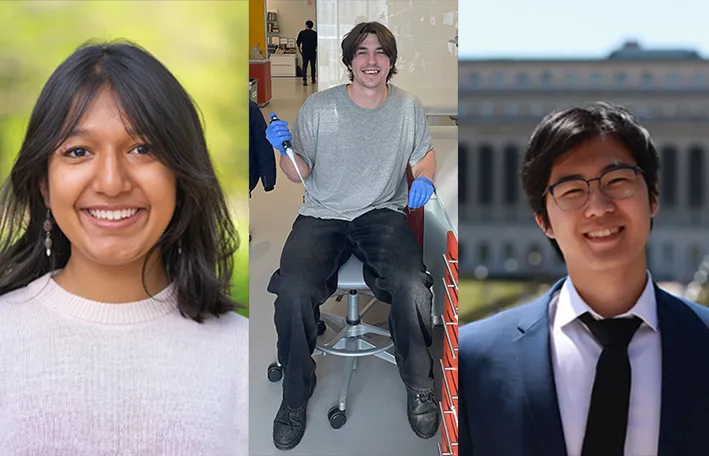
The 2026 Bridges and Sturtevant Prize for outstanding research was awarded to three graduating undergraduate students in the Department of Biological Sciences for “experimental or computational research is deemed to have been both highly original and fruitful by a committee of faculty to be selected by the Chair of Biological Sciences.” This year, the recipients are Aruna M Das, Lochlan Sife Krupa, and Younggi (Daniel) Moon.
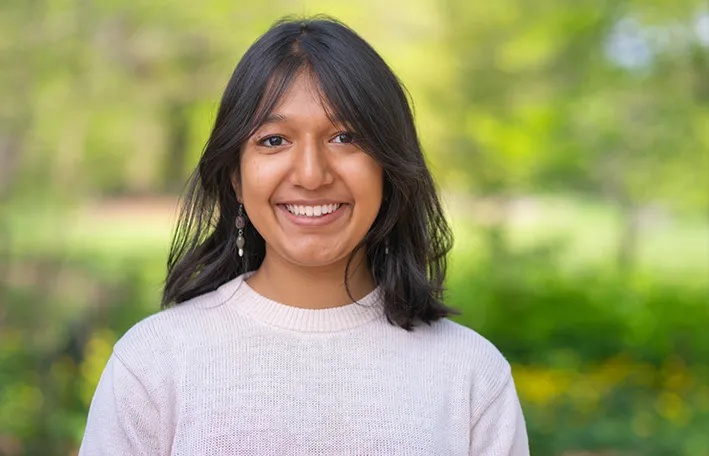
Aruna M Das
As an undergraduate in the Chalfie Lab, Aruna M Das (CC’26) studied how the nervous system processes competing sensory information and coordinates motor output. Nervous systems must coordinate multiple sensory signals to produce appropriate behavioral responses. To study this, Das used a mutant C. elegans worm that was failing to respond to multiple stimuli—because its nervous system’s balance was disrupted, one stimulus would overwhelm the worm such that it could not respond to another stimulus. Das demonstrated that this phenotype occurred because a gene responsible for neuron communication was disrupted, which left the worm unable to coordinate sensory inputs. Understanding how mechanosensory signals are processed and how they interact with motor outputs could help us develop targeted clinical therapies for sensory dysfunction in humans.
For Das, fond memories from the lab extend beyond her scientific discoveries. “My research has been especially rewarding because of how collaborative and supportive the lab I’ve been working in has been,” said Das. “I’ve always felt comfortable asking questions, and everyone has been willing to teach me new techniques and help me think through experiments.” After graduation, Das will be pursuing a Doctorate in Integrative Life and Environmental Sciences at the University of Oxford.
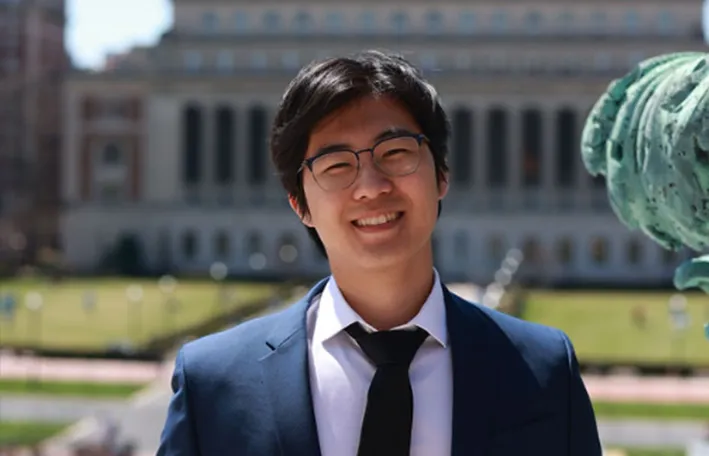
Younggi Daniel Moon
In the Sternberg Lab, Daniel Moon (CC’26) studied genome segments known as transposons. These genes, sometimes called "jumping genes", are interesting because they can move to different locations in the genome, but their regulation and evolution is poorly understood. Transposons can influence how organisms adapt over long periods of time, and understanding these elements may clarify how complex biological systems evolved through the activity of small, mobile genetic elements. During his undergraduate research, Moon discovered a small protein that is involved in the control transposon’s genes’ activities, which will help us understand how they change over time and has important applications for work in genome engineering.
“For me the most gratifying part of doing research is when something you've been working on for months finally shows you some interesting or unexpected data you can dig into,” said Moon. “Obsessing over a problem you care a lot about is a great way to feel really invested in the work that you do.” He will continue to obsess over mobile genetic elements by pursuing a PhD in Genetics at Stanford this coming fall.
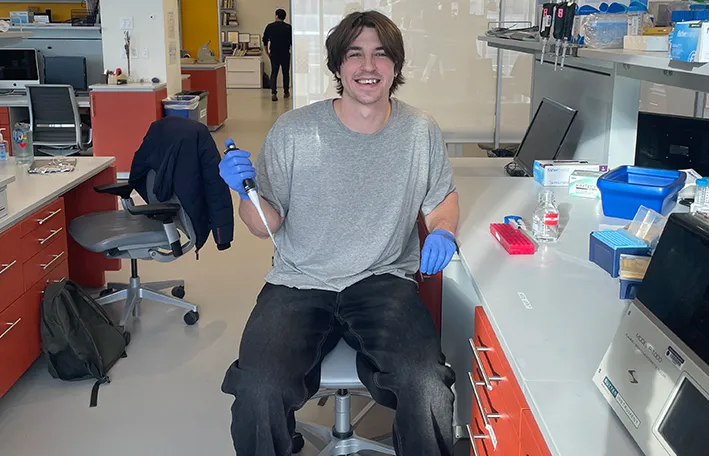
Lochlan Sife Krupa
During his undergraduate research in the Bendesky Lab, Lochlan Sife Krupa (CC’26) used ray-finned fish to conduct a detailed case study of the evolutionary trajectories and relative functions of duplicate genes. Ray-finned fish are an emerging model for genetics and development and can be genetically manipulated to help us understand the role of certain genes. Krupa designed a study that identified a gene that is essential for converting carotenoids into vitamin A during development. “I remember sitting at my desk looking at the results one by one and seeing that every single knockout fish had drastically lower vitamin A levels than the wild-type,” said Krupa. “It was a wonderful moment to have discovered something truly novel.”
Krupa further found that his gene of interest emerged through duplication of a gene found in all vertebrate species. His work not only has implications for the fish farming industry, but also explores the functional significance of duplicated genes throughout evolution. His work is described in further detail in a first author publication in Genetics. After graduation, Lochlan will be guiding backpacking trips and learning wilderness survival in Washington State while applying to PhD programs in evolutionary biology and genetics.