
Meeting the moment of data-driven discovery: A new framework for scalable and affordable 3D imaging
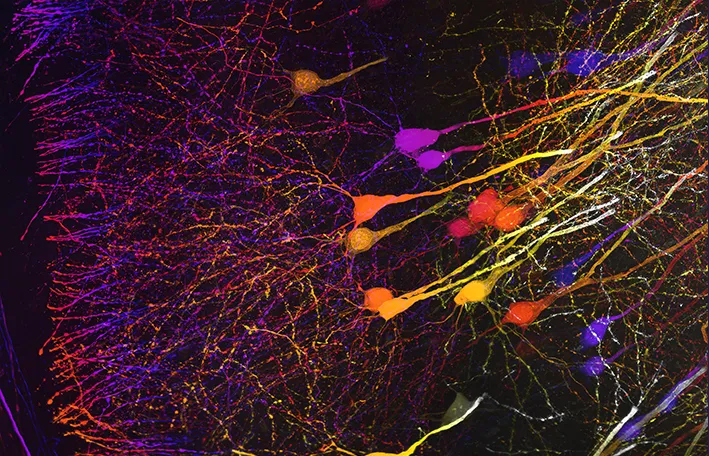
Imagine trying to understand a tree by looking only at images of cross-sections: the flat slices may tell you the diameter of the trunk, but little about the shape of the branches, whether the tree shelters animals, or how it fits into its environment. Yet many doctors and scientists doing biomedical research still rely on thin, two-dimensional slices of tissue, removed from their broader anatomical environment, to understand disease. New research by the lab of Dr. Raju Tomer published in Nature Biotech and featured in Columbia News aims to change this way of looking at disease. Doing so could be transformative for both research and medicine.
The human body’s landscape is composed of an intricate web of tissues and organs assembled into interconnected systems. Breast tissue, for instance, has a strikingly tree-like architecture: a cushion of fat and connective tissue surrounds a branching ductal network that links milk-producing glands to the nipple. Understanding how these anatomical structures interact in their full 3D context is essential not only for basic biology, but also for diagnostics and studying disease progression, including breast cancer.
But despite the evident importance of studying tissues within their spatial context, the ability to routinely capture and analyze three-dimensional information remains limited. Revolutions in quantitative approaches to biology have brought the field of biomedical modeling into its data-driven era, but bottlenecks remain. Tremendous advancements in computational power have been especially impactful, providing an avenue for 3D analysis of human biology, but only when sufficient high-quality data can be obtained. 3D imaging has been made possible by optical innovations: Tissue-clearing techniques have made opaque tissues transparent, and light-sheet microscopy (LSM) has emerged as the gold standard for imaging large, clear samples at high resolution.
Image Carousel with 2 slides
A carousel is a rotating set of images. Use the previous and next buttons to change the displayed slide
-
Slide 1: 3D histopathology rendering of an intact, large human breast tissue sample.
-
Slide 2: 3D histopathology of a human breast tissue sample showing invasive carcinoma with fibrotic focus features.
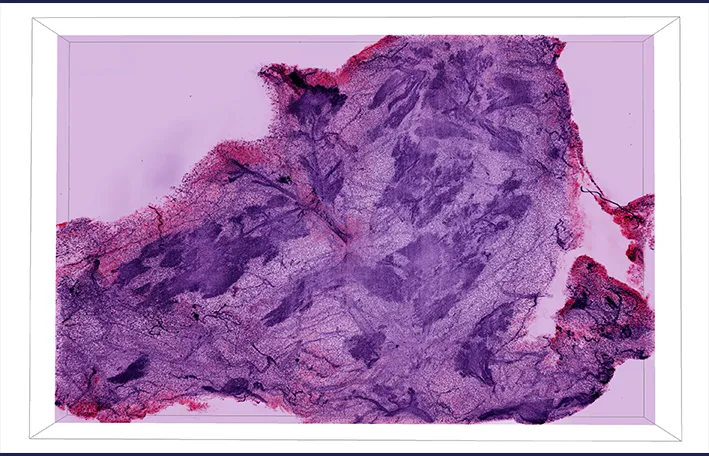
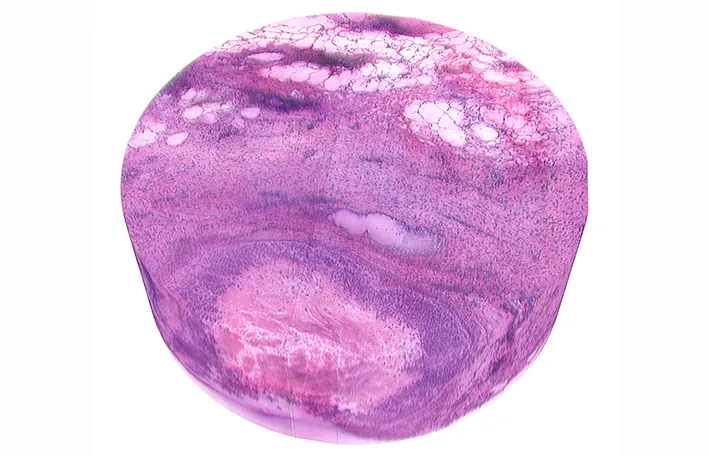
“LSM provides extremely high imaging speeds—more than 100 times faster than confocal microscopy,” Tomer explains. “But these systems have been super expensive…and they have limitations in how large a sample they can image, because of constraints in their detection optics. They’re also more complex to use than a standard confocal microscope.” As a result, there has been a lag in their widespread adoption for generating large enough volumes of high-quality 3D imaging data to fully harness the power of modern computational approaches.
This is the bottleneck that the Tomer Lab hopes to resolve. “The overall goal here is to make high-resolution, high-performance 3D imaging more broadly accessible and scalable,” says Tomer. “We want to enable the generation of large amounts of data from different types of tissues, organs, and pathologies to reach an organ scale understanding of normal and disease function.”
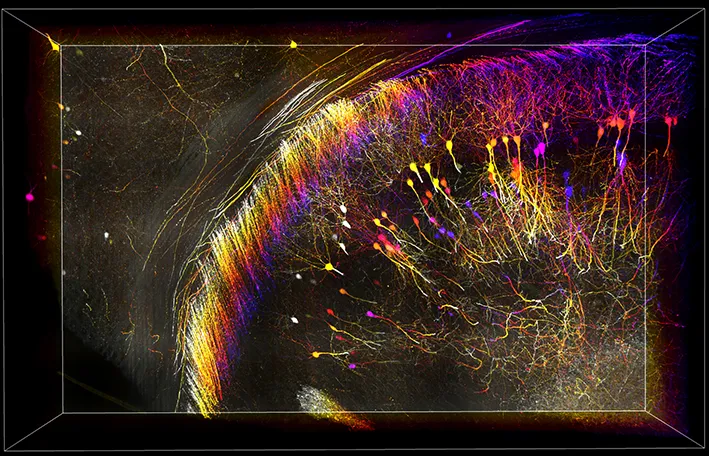
To overcome the data bottleneck, the Tomer Lab developed a new imaging approach built around a concept called Hybrid Solid–Liquid Optics: pairing a solid optical element with a liquid whose refractive index precisely matches the solid. This new framework helps directly address longstanding limitations in microscopy. Traditionally, researchers must choose between high-resolution immersion objectives—which are extremely expensive, have short working distances (meaning they cannot image very deeply into a sample), and are narrowly optimized for a particular refractive index—or inexpensive air objectives, which offer long working distances, but suffer from optical aberrations that can result in a loss of signal and resolution. Hybrid Solid–Liquid Optics offers the best of both worlds. “What we’ve done is essentially turn an inexpensive air objective into a high-resolution immersion objective, while keeping all the advantages of air objectives,” like long working distances, low cost, and broad compatibility across sample types and preparations.
The team integrated this optical innovation into their previously developed low-cost LSM system—already about 40 times cheaper than commercial platforms. “The result,” Tomer says, “is a cheap system that can outperform the most expensive microscopes on the market.”
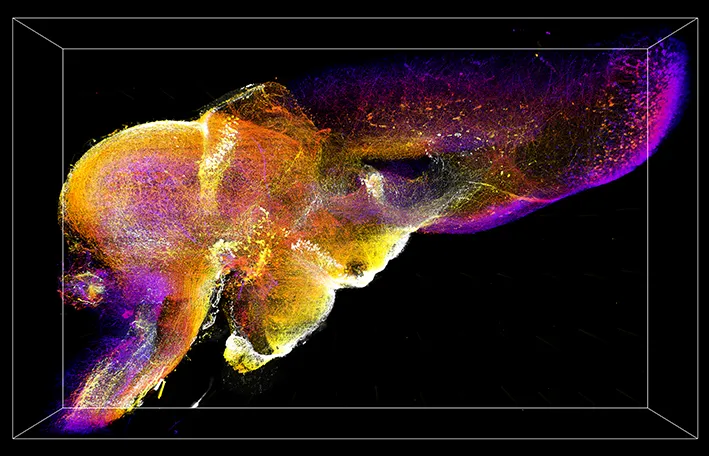
This has transformative implications for clinical settings. Specialists can now assemble detailed, three-dimensional reconstructions of patient tissues—such as the complex, branching architecture of mammary ducts—without sacrificing resolution or imaging speed. For pathologists, who rely on tissue architecture to characterize tumors and understand disease progression, the ability to examine 3D tissue samples at subcellular resolution could significantly enhance diagnostic precision.
Molecular pathologist—and collaborator on Tomer’s work—Dr. Hanina Hibshoosh notes that this shift from two-dimensional slices to volumetric imaging could fundamentally change how disease is detected and understood. “In pathology, we normally look at things in 2D,” Hibshoosh explains. “We generate sections, we look under the microscope, and maybe we sample a few levels, but we often don’t know what’s deeper in the tissue block. Technologies that allow 3D elucidation can help define whether there’s something deep that could be missed, and more broadly, they provide spatial information that can be relevant for diagnostic, prognostic, and predictive purposes.” According to Hibshoosh, understanding tissue geometry in three dimensions—particularly the tree-like organization of exocrine systems like the breast—is critical to truly understanding otherwise hidden biological principles. “Fibroadenoma, for example, the most common benign tumor in the breast—you’re going to have a much clearer understanding of how that lesion develops by having an understanding of what the tree architecture is. If you think about it long and carefully, that architecture defines the biology, it defines how the tumor comes about.”
Beyond pathology, a more scalable and accessible imaging platform opens new doors in developmental biology, regenerative medicine, and large-scale anatomical mapping efforts. Most critically though, it enables a more universal contribution to the generation of the high-quality volumetric imaging data necessary for modeling function at the organ scale and uncovering biological patterns that cannot be seen from a two-dimensional perspective.
As Tomer notes, “If you have lots of data, you can solve complex problems.”
This work was supported by funding from the National Institutes of Health (NIH). Tomer also wishes to acknowledge the contributions of Cheng Gong, a PhD student in the lab who led key aspects of the 3D histopathology and optical analysis, and Pauline Affatato, whose rotation work was a significant component of the study, as well as collaborators including the MBF Bioscience team, Sudha Guttikonda, Rene Hen, Christopher Makinson, Renee Mapa, Johanna Kowalko, Dan De La Cruz, Maria Tosches, Chip Gerfen, and Hanina Hibshoosh.
This research was featured in an article in Le Monde as well as in Photonics Spectra, a leading industrial photonics trade magazine, and you can read a summary of the research in this Nature Research Briefing.