
Leveraging the Gut Microbiome to Treat Disease and Improve Human Health

Most of us have taken a probiotic at some point in our lives. Or at the very least, we’ve found ourselves reaching for the probiotic-enriched yogurt at the grocery store to try to increase the “good” bacteria in our guts. These “good” bacteria support our digestive system in breaking down foods. They also produce key nutrients and prevent the invasion of harmful, pathogenic or toxic bacteria. But how do these populations of bacteria establish themselves in our gut? And how do the good bacteria protect us from the bad bacteria? A recent study published in Cell by postdoctoral fellow Menghan Liu and her advisor, Dr. Saeed Tavazoie, sheds light on these questions about the microbiome and suggests new avenues for supporting human health.
Babies are born germ-free. Over time, by eating various foods and touching different surfaces, each of us develops a diverse and robust society of bacteria that settle in our stomachs. To establish a colony in the gut, bacteria need to be able to 1) survive the harsh conditions of stomach acid and 2) co-exist with the bacteria colonies already present. The good bacteria protect our bodies by “colonizing” the gut, outcompeting the pathogenic bacteria for resources so that they cannot survive. Understanding what factors are important for these “good” bacteria to thrive and outcompete harmful bacteria is crucial for supporting human gut health.
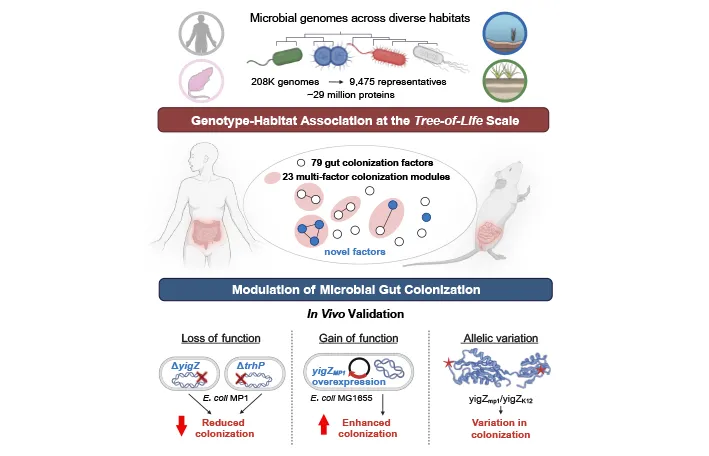
In their new paper, the Tavazoie lab uncovers which factors are important for bacterial colonization of the gut. To accomplish this, they compared the protein-coding genes of thousands of species in order to find genes that are enriched in the bacteria living in the gut. Their hypothesis: genes essential for gut colonization are exclusively enriched and highly expressed in gut bacteria. The large-scale “tree of life” approach yielded many new, gut-specific gene families that were possible colonization factors. The top gene families encoded proteins for transporters, metabolic factors, quorum sensing (bacterial signaling), enzymes, and proteins involved in making other proteins, specifically for translating mRNA into amino acids. Using a novel genomic barcoding approach to test multiple colonization factors, Liu experimentally validated two of the top gene candidates that indeed encode factors important for E. coli residing in the murine gut environment. Through her study, Liu was able to find and manipulate genes that could turn poor gut-colonizing bacteria into an excellent gut-colonizing bacteria.
The Tavazoie Lab’s findings in the gut microbiome have far-reaching implications in studies of immune, psychiatric, and metabolic conditions, all of which are connected to the gut. “We can use these colonization factors to see how the microbe population is shifted in disease states,” says Dr. Tavazoie. “Our pipeline and findings are proof of concept that these colonization factors can be used to modulate specific bacteria, enabling us with good efficiency to control the gut microbes and potentially purposely outcompete harmful bacteria or deliver therapeutic compounds to the human host.” These findings from the Tavazoie lab are an exciting step forward in leveraging the gut microbiome to treat disease and improve human health.