
2026 SURF Symposium Celebrates Undergraduate Research
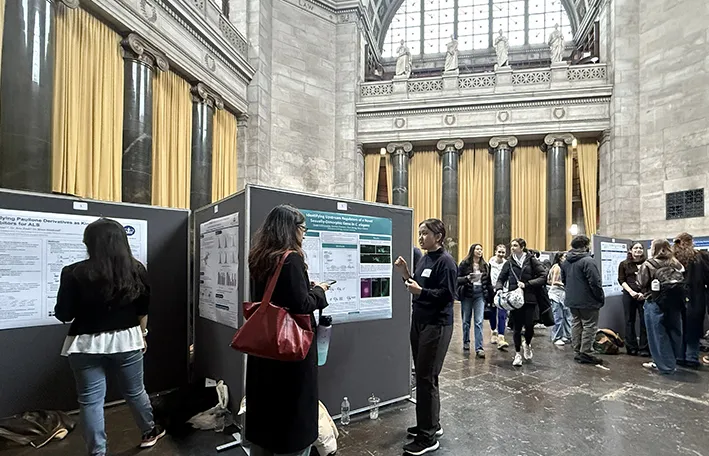
On Friday, March 6th, Columbia University students, faculty, and staff gathered in the Low Library Rotunda for the annual SURF Summer Research Symposium. The building was originally the University’s main library, with the rotunda serving as a reading room for scholars a century ago. Though no longer a library, the granite dome soaring over 100 feet high, feels appropriately grand for housing the posters of the sixty-three undergraduate students who conducted cutting-edge research in biological sciences through the Summer Undergraduate Research Fellowship (SURF) program.
The SURF program, which has been active since the 1980s, offers students the opportunity to conduct hands-on biology-related laboratory research for ten weeks during the summer. Under the mentorship of research scientists at labs across Columbia’s Morningside campus, the Zuckerman Institute, and the Columbia University Medical Center, they complete independent projects that culminate in a poster symposium the following spring. Student projects span an impressive range of fields, including biochemistry and molecular biophysics, genetics and development, medicine, microbiology and immunology, neurology and neuroscience, and systems biology.
One of the first posters one encountereed upon entering the space boasted a vibrant diagram of a mosquito’s life cycle. The presenter, Adam Spree (CC’28) was surrounded by a group of curious Intro to Biology students. Adam worked in the Duvall lab during the summer and fall of 2025, where he (bravely) studied how a mosquito regulates how much blood they consume when they bite a human host.
“Coming into the summer, I didn't think I would discover anything,” said Spree. “But we did find some really interesting data about different receptors in the mosquito gut.” Before mosquitos actually bite a host, his poster explains, they use powerful cues to identify and find this suitable meal. While mosquitos only bite humans in their adult state, they actually spend their larval and pupal states in the water, where they must use their sensory systems to find the food sources necessary to develop and transition from the aquatic to terrestrial state. “Maybe we could translate these findings into a practical solution for disease transmission control.”
A few posters down, Therese Zinga (SEAS’27) presented research on a different animal making a similar transition. Her work with Dr. Andrew Matheson, a postdoc in the Tosches Lab, focused on the how newts adapt to living on land. Newts undergo many morphological changes when they transition from water to land as they age, so Matheson and Zinga asked what changes the brain undergoes during this time. They found that the cells in aquatic newts’ brains have increased neurogenesis, a state of growth and development, as compared to their terrestrial counterparts. Zinga credits her impressive progress in the lab to her ability be in the lab full-time and continue her research into the academic year. “SURF set me up to be more involved during the semester,” she says. “I was able to grow as a researcher, be more independent, and also gain a lot of technical skills.”
Neural plasticity is also an important topic for scientists who study neurodegenerative diseases in humans. Aania Garg (CC’27) used a mouse model in the lab of Dr. Rene Hen in the Department of Psychiatry to study how age affects memory. Garg found that aging might actually make the brain less flexible, making it more difficult to distinguish new memories from old ones. She looked at mouse cell activity using live-imaging microscopy techniques. “I really like doing the imaging,” said Garg. “It’s really interesting to actually see how their neurons are activating in real time.” Like Zinga, she also pointed to the benefit of being able to conduct research full time. “Before SURF I was probably in the lab once a week. I was only focusing on one area, but this summer I really got to see the whole picture.”
Supporting undergraduate students in research labs is not only valuable for their resumes, it also gives students the chance to learn which fields excite them and can help spark their scientific interests. “I'm actually working towards a thesis in psychology or neuroscience,” said Garg. “I think that overall SURF and the research really set me up for that foundation.”
The SURF program would not be possible without the generous support of the Amgen Foundation, Columbia College, the Fu Foundations School of Engineering and Applied Science, the Cancer Center, The School of General Studies, the Graduate School of Arts and Sciences, Richard Axel, Norman Annenberg, the department of Biological Sciences and the SURF Mentors and host labs. The program is successful thanks to the tireless efforts of SURF/Amgen Program Coordinator, Chanda Springer, and site director, Dr. Alice Heicklen.