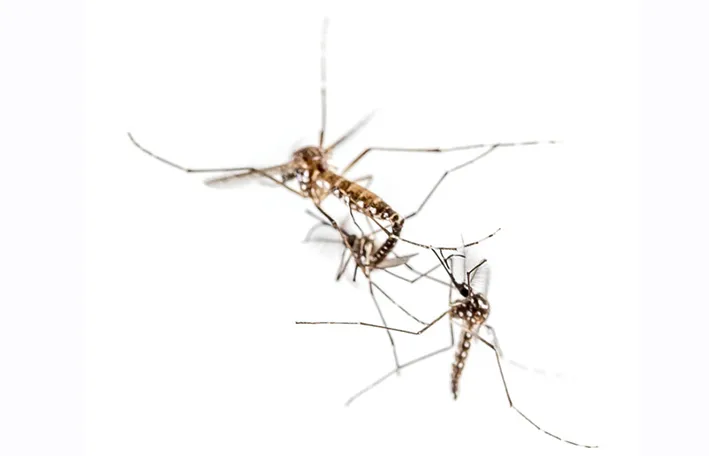
Dr. Laura Duvall received a CAREER Award from the National Science Foundation, one of the NSF's most prestigious honors for early-career faculty, recognizing both research excellence and a strong commitment to education and outreach. The award will support her lab’s work to understand the biology of mosquito mating behavior, with implications for the control of mosquito-borne diseases including dengue, Zika, and chikungunya.
The Duvall lab’s research will help inform sterile-male release programs, a mosquito control strategy whose effectiveness depends on understanding mating dynamics. Female Aedes aegypti mosquitoes typically mate only once in their lifetime. During mating, males transfer chemical signals that permanently suppress the female's receptivity to future mating, ensuring that he fathers of all of her offspring. Duvall's lab will investigate how females detect these male-derived signals, how this process may differ when females encounter males of other species, and how that information is relayed through neural circuits to produce a permanent behavioral change. The project includes a research partnership with a Florida Vector Control Agency to collect mosquitoes from different habitats, as well as a training component for undergraduate researchers, who will participate in fieldwork, laboratory experiments, and science communication activities.
The CAREER Award will support new research that builds on recent work from the lab, published as a preprint, showing that certain mosquito populations in Florida have evolved resistance to a natural form of mating disruption. This work will advance our understanding of the fundamental biology of mosquito reproduction, with translational potential to support the development of more effective strategies for reducing mosquito populations and preventing vector-borne disease.