
Dr. Ella Doron-Mandel selected as the 2025 winner of the Charles H. Turner Award
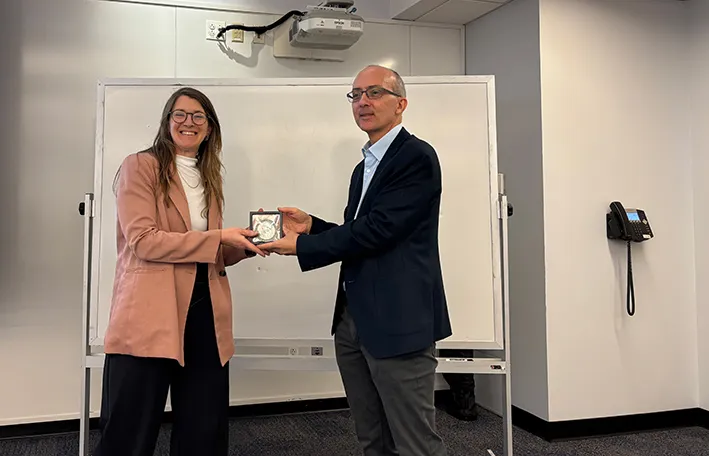
Dr. Ella Doron-Mandel, a postdoctoral research scientist in the lab of Marko Jovanovic, has been awarded the fourth annual Charles H. Turner Award.Charles H. Turner was a pioneer in zoology and entomology, known for his contributions to insect behavior research as well as his activism for civil rights. The award in his honor recognizes outstanding research performed by a postdoctoral scientist within the Department of Biological Sciences, and Doron-Mandel was selected for developing a new way to study proteins.
From breathing and eating to running and thinking, the biological processes essential to our lives are reliant on the work of proteins. Proteins are the main actors within a cell, playing a myriad of roles. If an organism were a city, proteins would be the construction workers, the postal service, the transit system, and the infrastructure, the mail, and the citizens. When you consider the scope of functions performed by the entirety of proteins within a cell, tissue, or organism—also known as the “proteome”—, it becomes apparent why studying the proteome is equally as critical to understanding biology as it is challenging.
Because proteins are involved in nearly every biological function, the body must tightly control how they are made, maintained, and broken down. Studying how these systems work (and how they fail) yields powerful insights into aging and disease, but the current tools we have for studying the proteome have major limitations.
One challenge in proteomics is understanding protein complexes. In the cell, proteins rarely work alone—they often come together to form complexes that perform unique functions. A single protein might help build cellular structures in one complex, while controlling which genes are turned on or off in another. Being part of a complex can also affect how long a protein lasts in the cell and how it behaves.
Unfortunately, most current proteomic methods only measure the total amount of a protein. They can’t tell whether a protein is part of a complex, or which complex the protein is in. Proteins also often undergo post-translational modifications (PTMs)—chemical changes that occur after a protein is made and can dramatically affect its function. Most existing protein measurements miss this too, leaving out critical context.
To address this, Doron-Mandel developed a method called SEC-MX (Size Exclusion Chromatography fractions MultipleXed), which integrates measurements of both protein interactions and PTMs into her proteomic studies. With this approach, cells are gently broken apart, their proteins (or protein complexes) are filtered by size, and the proteins within these size-separated fractions are identified and measured for post-translational modifications. The key breakthrough with this technique is that both protein interactions and modifications are measured simultaneously, whereas previous studies were limited to one or the other.
After developing SEC-MX, Doron-Mandel combined it with metabolic labeling, a method that provides a readout of protein stability—how long a protein persists before being broken down— to study protein lifespans. These lifespans can last anywhere from minutes to years, and the duration provides critical insights into the protein’s role in aging, disease, and response to cellular stress. Doron-Mandel found that proteins involved in complexes often had longer lifespans than the same proteins on their own. Even more intriguing, she discovered that this balance could break down in older mice for some proteins, and single proteins weren’t cleared away as efficiently. This demonstrates a fascinating implication of aging on protein regulation by suggesting a mechanism for protein accumulation, a hallmark of age-related disease.
Going forward, SEC-MX will allow researchers to ask new questions about how proteins function in specific contexts. One area Doron-Mandel is especially excited about is understanding how certain proteins—called RNA-binding proteins (RBPs)—contribute to the brain’s wiring. RPBs play a key role in controlling gene activity, which ultimately affects how neurons form and modify their connections. However, these proteins form many different complexes, and the sets of genes they influence depend heavily on which complex they’re in. This has made it especially challenging for scientists to pinpoint exactly how any one particular RBP impacts neuronal wiring. “To fully understand RBP function,” Doron-Mandel says, “it is essential to map RBP interactions at the level of protein complexes and study their function in a context-specific manner.” With SEC-MX, future experiments can map these protein interactions more precisely and in the relevant contexts, which could lend new insights into learning, memory, and neurodegeneration.
Dr. Doron-Mandel wants to see her research offer biologists a new perspective on proteins. “I hope [this work can] inspire researchers to investigate how their favorite proteins of interest integrate into complexes and whether differential interactions can explain some of the molecular phenomena they see.” Her work illuminates the interplay between various modes of protein regulation, enabling scientists to see a fuller and more intricate picture of the complicated dynamics that govern the proteome.
Ella Doron-Mandel presented her research at the Charles H. Turner Postdoc Award seminar on Monday, October 6th. She would like to thank her collaborators and the Jovanovic Lab, specifically Marko, Ben Bokor, and Yanzhe Ma. She is supported by the National Institute for Neurological Disorders and Stroke K99 award (NINDS K99NS135103).