
This future life sciences consultant has spearheaded collaborations and applied a novel method.

“I found it really intriguing how such a small molecule, at the micro level, could orchestrate organisms so complex as humans.”
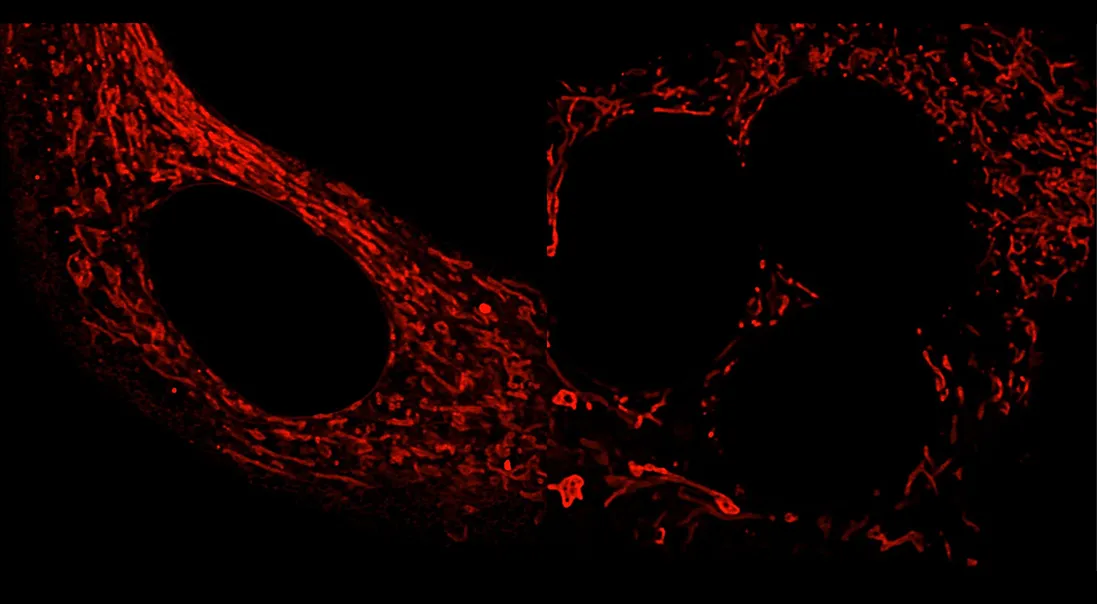
Ferroptosis, a form of iron-regulated cell death, has been primarily linked with cellular compartments such as the endoplasmic reticulum. But during her PhD research, Qiulin Zhu discovered that one small-molecule compound acts primarily through mitochondria to induce ferroptosis.
“That’s when we really got interested in and committed to this project,” Zhu recalls.
Now in her fifth year, PhD candidate Qiulin Zhu led a transnational collaboration across five research facilities and applied a brand-new method to understand the compound’s mechanism of action. She’s currently wrapping up her PhD in Dr. Brent Stockwell’s lab in the Columbia University Department of Biological before starting her career as a consultant.
Since attending high school in Sichuan, China, Zhu has been fascinated by DNA’s interduplex structure and how small changes in DNA can lead to mutations—and potentially also disease. “I found it really intriguing how such a small molecule, at the micro level, could orchestrate organisms so complex as humans,” she recalls.
“When choosing programs, choosing the city where I could see myself living for the next five years was very important. New York is very exciting.”
Zhu attended the University of California, Berkeley, as an undergraduate. Her experience working in labs there introduced her to transcription factors and helped her realize she wanted to focus primarily on translational science. “I wanted to do more cellular biology and biology related to disease, where I could see a direct impact,” Zhu explains.
Then the COVID-19 pandemic brought the world, and her research, to a halt. Zhu chose to graduate early and return to China as a visiting scholar at Southern University of Science and Technology. There, she built a transcriptional inhibition tool for knocking out genes while she applied to graduate school.
Columbia stood out because of the school’s flexibility in allowing her to interview across time zones. It also represented a chance to live on the East Coast. “When choosing programs, choosing the city where I could see myself living for the next five years was very important,” Zhu says. “New York is very exciting.”
She landed in Stockwell’s lab, studying ferroptosis with the person who discovered it. “Being in this lab gives me a front-row seat to understanding this more recently discovered cell death,” Zhu explains. Zhu works on cancer, and some of her lab mates work on ferroptosis in neurodegenerative diseases. “It all has translational potential,” she says.
Based on her past research experience, she knew she would work best in a large lab with a principal investigator who afforded her independence, which she found in the Stockwell lab. “I can just feel the trust and the autonomy he gives to his students,” Zhu says. “But if you need help, he’s always there.”
Zhu’s PhD work came about because she was working with a small molecule compound that she knew induced ferroptosis, but she wasn’t sure how. She set out to solve this novel ferroptosis inducer’s mechanism of action.
After discovering that the compound induces ferroptosis through the mitochondria, Zhu began trying to narrow down compound’s exact molecular target. “That’s when all the collaboration began,” she recalls.
First, Zhu collaborated with Columbia’s Proteomics and Structural Biology Shared Resource at the Herbert Irving Comprehensive Cancer Center to systematically profile changes in the global protein to see which proteins were upregulated and downregulated after treatment with the drug, hoping to find the compound’s direct target. That experiment didn’t give them much insight—which makes sense, given that they later realized the compound has multiple targets.
Next, Zhu collaborated with Markus Siegelin’s lab in Columbia's Department of Pathology and Cell Biology to measure how the small molecule affected the cell’s respiratory capacity. (A decrease in cellular respiration can indicate a dysfunction in the mitochondria.) And Columbia’s Confocal and Specialized Microscopy imaging facility helped her take a high-resolution look at how the mitochondria’s structure changed after she treated the cells with her compound.
She also worked with Raphaël Rodriguez of the Curie Institute in Paris, who uses a chemical-biology–based imaging approach to track how small molecules enter and localize within cells. Altogether, the collaborations helped her establish that the molecule disrupts mitochondrial function.
Zhu then returned to the Columbia proteomics group, seeking to apply a novel method that had just been reported in a paper. When a molecule is heated, the proteins denature. But a drug binding to one protein can stabilize it and increase its melting point.
“Columbia has a lot of shared resources that different labs can use. That definitely helped to push my project forward. Without those experiments, I could not have the data I have now.”
Given how new the method was, “I’m really grateful that my PI would allow me to try and then apply this method to my project,” Zhu says. And the gamble paid off: the method allowed them to narrow down and validate their mitochondrial targets.
Finally, working with Andrea Califano in the Department of Systems Biology, Zhu took advantage of a novel computational method to predict a drug’s mechanism of action based on its gene expression profile.
“Columbia has a lot of shared resources that different labs can use. That definitely helped to push my project forward,” Zhu says. “Without those experiments, I could not have the data I have now.”
Outside the lab, Zhu has amassed a following as a food blogger on the Chinese social media site RedNote, and restaurants around New York invite her to sample their menus. “All my friends are on my roster of who to bring when I eat free meals,” she says.
Her skills as a convenor extend beyond the lab: she has also collaborated with a start-up founder building an app to distribute surplus food from schools, local vendors, and restaurants to people in need throughout New York City’s Morningside Heights neighborhood.
One of her most impactful experiences has been with the Columbia Technology Ventures Fellows Program, which trains graduate students and postdocs to evaluate the commercial impact of new inventions. She describes it as a tight-knit community with a strong alumni network that supported her while she was job-hunting and shaped her interest in consulting.
After Zhu graduates, she will start as a life science specialist at LEK Consulting, where she will help biotech and biopharma clients with commercialization, go-to-market strategy, and other challenges. Of her time at Columbia, she says, “I have built a lot of skills that are transferable for my future career post-PhD.”
By Alexandra A. Taylor