
Columbia offered a chance to live in New York City and a personal touch: after interviewing with the Columbia University Department of Biology, several professors reached out to continue their conversations, including Ide’s future adviser.
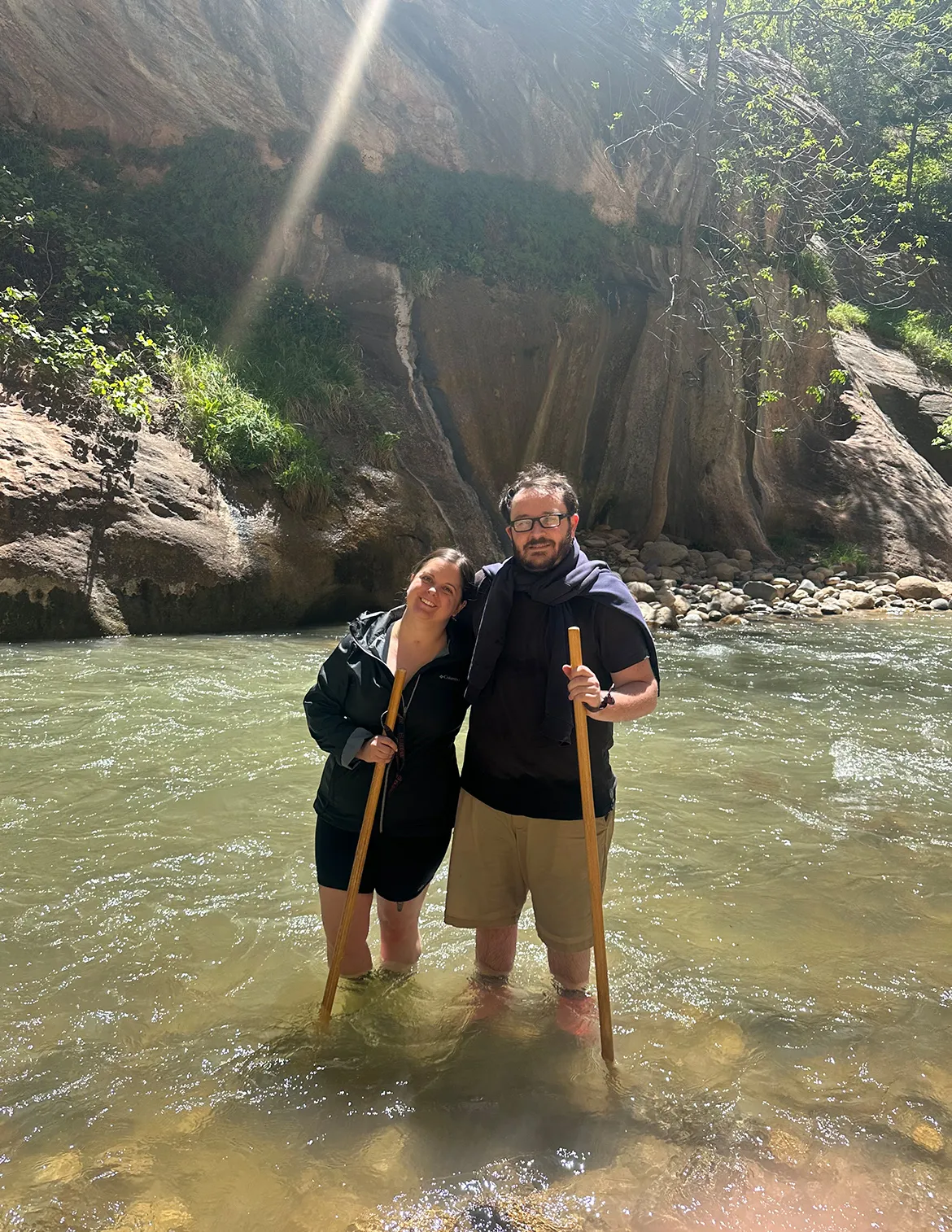
When he’s not studying the molecular mechanisms of mRNA translation, Ide teaches science in prisons.

Graduate students often gain experience teaching undergraduates. But Ide’s story is a little different: he counts teaching science in prisons among his most impactful grad school experiences.
A sixth-year PhD candidate in Dr. Ruben Gonzalez Jr.’s lab, Ide studies mRNA translation initiation in eukaryotes. His connection to the Center for Justice at Columbia helped to crystallize his passion for teaching science to incarcerated students.
Ide grew up in West Jordan, a suburb of Salt Lake City. His father, a civil engineer, nurtured his interest in science. Throughout high school and college, “my interests always seemed to take me to the next step down: the organismal level, the cellular level, the molecular level,” Ide says. “I think I’ve settled now.”
After reading a book about N,N-dimethyltryptamine (DMT), a psychedelic drug that researchers are investigating for its potential to treat mental health disorders, Ide realized for the first time that people can do research as a career, which he calls a “a big moment in my scientific path.”
As an undergraduate, he volunteered in a lab studying the molecular mechanisms of the flagellar motor—essentially, how bacteria swim around. At the time, Ide was working multiple jobs to avoid student loans. His adviser offered to pay him to work part-time, which allowed him to spend more time in the lab.
This research experience led to a job in a start-up, T3S Technologies, that had spun out of the lab. The start-up used bacteria’s high-efficiency system for secreting flagellar proteins to express and purify other proteins. Working as a laboratory specialist for T3S confirmed for Ide that he loved being in the lab and wanted to continue with research.
Ide appreciates having the freedom to explore any of his broad research interests and ideas that overlap with the lab’s goals. “Ruben quite literally will let me pursue whatever I want, which is awesome,” he says.
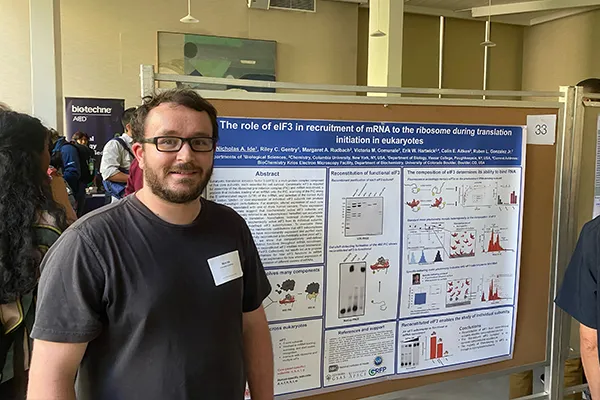
When it came time to apply to grad schools, “I was committed to leaving Utah because I had grown up there,” Ide says. “I was ready for a change of scenery and to challenge myself by living somewhere else.” Columbia offered a chance to live in New York City and a personal touch: after interviewing with the Columbia University Department of Biology, several professors reached out to continue their conversations, including Ide’s future adviser.
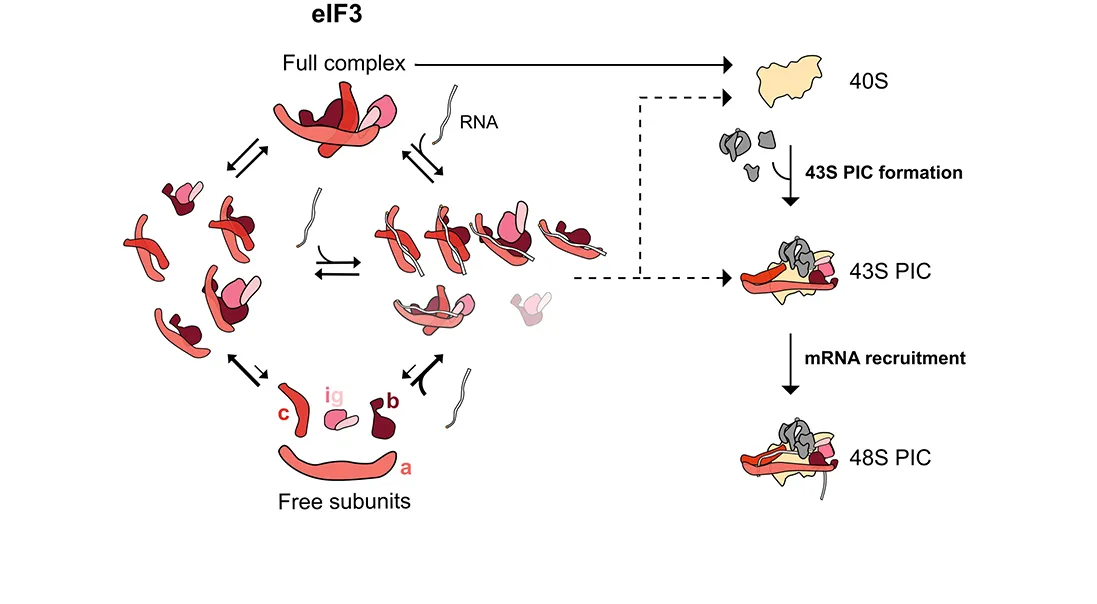
Ide ultimately landed in Gonzalez’s lab, where he studies the eukaryotic translation initiation system, which involves 20 different factors. When he joined the lab, Ide says the attitude was, “Just choose a factor you want to study, and there will probably be interesting questions.” Ide chose eIF3, a protein complex that binds ribosomes and mRNA during mRNA translation.
Ide entered Gonzalez’s lab expecting to study eIF3 using single-molecule FRET microscopy (smFRET), their lab’s popular tool. But his experiments didn’t go as planned. “I was prepared. I had fluorescently labeled eIF3, was ready to do these studies—and they were super complicated,” he recalls. “It didn’t make any sense.”
Although eIF3 appears to be one big complex, Ide has since discovered that’s not the right way to consider it; instead, eIF3’s five protein subunits “come on and off in a dynamic way, allowing them to sample biochemical activities,” he explains. Knowing now that the subunits come apart and interact, it makes sense that smFRET experiments, which require the fluorescent label to remain tethered to the microscope slide, did not work. Instead, Ide used other single-molecule techniques to study eIF3’s activity. He shares these findings in his most recent bioRxiv preprint, which looks at eIF3’s ability to bind directly to RNA.
Ide enjoyed a close collaboration with another grad student, Riley Gentry, in this work and in studying eIF4F, a key factor in cap-dependent mRNA translation initiation. “Riley and I go back and forth about science for any of our projects,” Ide says. “His day-to-day is largely thinking about eIF4F and working with those molecules, mine is working with and thinking about eIF3.” The pair worked together on another bioRxiv preprint that proposes a new model for how the factors that make up eIF4F isolate and recognize the cap on messenger RNA.
Ide appreciates having the freedom to explore any of his broad research interests and ideas that overlap with the lab’s goals. “Ruben quite literally will let me pursue whatever I want, which is awesome,” he says. And this encouragement extends beyond the bench. After Ide shared his interest in prison education with Gonzalez, his adviser introduced him to Dr. Geraldine Downey, the director of the Center for Justice at Columbia.
Since connecting with the Center for Justice, Ide and another member of his lab, Anjali Verma, have worked to design a new course on science in society that could be taught inside prisons. Ide has taught a physics course at Taconic Correctional Facility, a medium security women’s prison, and served as a teaching assistant for an earth science course at Sing-Sing Correctional Facility, a maximum-security men’s prison. He says that much of prison education skews toward the humanities and that the students responded enthusiastically to learning science.
Ide has enjoyed the support of both his adviser and his department for teaching inside. “Teaching in prisons was one of the coolest things I was able to do in grad school,” he says. He sees it as eminently useful to both the students and to society, and he is searching for a postdoc that will allow him to continue.
The experience has also influenced how he teaches outside of prisons, whether that’s trying out different techniques or learning to “just be OK with whatever happens.” After being denied entrance to the prison, having his classroom moved unexpectedly, and having students missing from class without explanation, he’s learned to accept the conditions he’s dealt. “I’m much better at dealing with uncertainty than I used to be,” he says.
This attitude of acceptance has served him well. Ide is proud of the personal growth he’s experienced during his time at Columbia. “Doing a PhD and the experiences I had throughout grad school have made me a much more prepared human,” he says. “I am much better equipped for the reality of what a career in science looks like.”
By Alexandra A. Taylor