
This curiosity-driven chemist made the leap to behavioral neuroscience.
“I love being in this childlike curiosity incubator, where your day-to-day is just wondering how things work, and you don’t have to think about making a tangible product or a cure immediately.”

Whether studying circadian rhythms or singing a cappella, Linhan Dong has followed his curiosity and marched to his own beat.
Dong grew up in Jilin, China, a province in northeast China that borders Russia and North Korea. Taking a shine to chemistry from an early age, he was in middle school when he started doing experiments at home with friends.
“That was the first time I got to do science on my own terms, not just what we got to do at school,” he recalls.
He completed his first two years of undergrad at Jilin University, then journeyed to the University of Groningen for the second half of a joint bachelor’s program. The Dutch program’s life science focus exposed him to the interface of biology and chemistry.
“It was a fun reach going from my basic understanding of these molecules to animals and behavior and genes,” he recalls. The experience helped him discover a love for basic science and sparked his interest in pursuing a PhD in biology.
“I love being in this childlike curiosity incubator, where your day-to-day is just wondering how things work, and you don’t have to think about making a tangible product or a cure immediately,” he says. At the same time, basic science can yield discoveries “that can then be fundamental to medicine and engineering—to the big progress we see in society.”
“New York is a place I can feel I belong because everyone is different.”
As an undergraduate, he worked with an enzymologist, Dr. Dick B. Janssen, to characterize an enzyme that was engineered to be more thermally stable. He was drawn to apply his chemical expertise to biology in the Columbia University Department of Biology in part because the department’s umbrella program would allow him to explore multiple interests.
More than anywhere else he’s studied, Dong feels most at home at Columbia and New York City because of their diversity. “New York is a place I can feel I belong because everyone is different.”
After rotating in several labs, including one in the chemistry department, he landed in the lab of Dr. Laura Duvall, who studies the behaviors that make mosquitoes dangerous vectors of disease-causing pathogens.
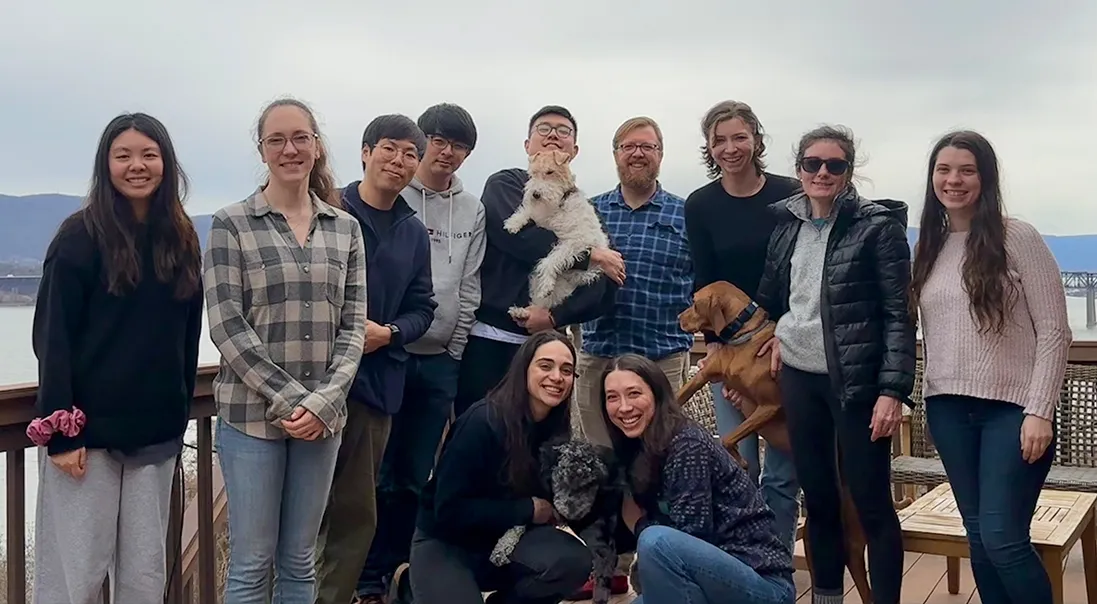
“I found my mentor to be a very inspirational figure,” he says. Dong was among one of Duvall’s first graduate students, and he says being able to help build the lab from the ground up gave it the feel of a scientific playground.
Coming from chemistry, the variety of methods at his disposal was also compelling. “I can go all the way from things I was exposed to as a chemist, like molecular genetics, all the way to things I was never even thinking about, like gluing pieces of acrylic to build an apparatus to read out mosquitoes’ drive to bite,” he says. “This combination of arts-and-craftsy things—plus getting to engineer their genome using CRISPR-Cas9—gives me this really nice spectrum of things that I’m able to do.”
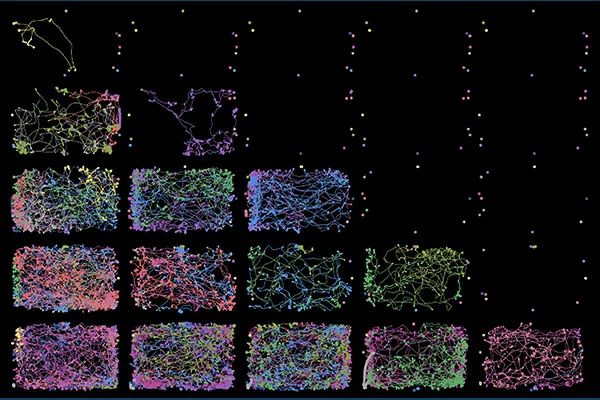
In a paper recently published in Proceedings of the National Academy of Sciences, Dong and colleagues determined that mosquitoes’ circadian rhythms drive them to respond most persistently to CO₂, a potent human host cue, at dawn and dusk. These are exactly the times of day when this species bites most actively. By using CRISPR-Cas9 tools to knock out a circadian clock neuropeptide, Pigment-Dispersing Factor (PDF), the team determined that mosquitoes without the neuropeptide were inefficient at biting, but only in the morning.
“I found my mentor [Laura Duvall] to be a very inspirational figure.”
In another recent paper, published in Cell Reports, Dong applied these skills to a different biological question: how the circadian rhythm affects egg laying. They established that after feeding, female mosquitoes with mature eggs transition from rest to hyperactivity as they begin seeking a humid spot at night to lay their eggs.
“Comparing between the mosquito with a functional clock and without a functional clock, we see a big difference in terms of egg-laying efficiency,” he says. The mosquitoes without a functional clock had a much harder time producing viable offspring.
Outside of the lab, Dong is an a cappella singer and competes against other regional groups. He’s currently arranging music for an upcoming competition. He says a cappella has been a great way to meet other people on campus and has positively impacted his daily life in the lab. “Sometimes, a distraction or a little bit of a break from your work is exactly what you need to advance your work,” he adds.
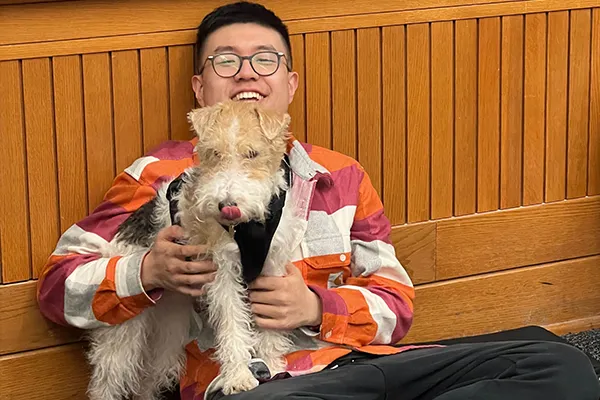
One of Dong’s proudest achievements is caring for his dog, Beta, a four-year-old wire fox terrier. As an international student who cannot easily visit home, “I cannot imagine how my grad school experience would have been without my dog,” he says. “She brings me a lot of joy.”
Dong’s hobbies and his love for exploring have help him maintain balance throughout grad school. “Having friends in New York City, hearing a lot of different perspectives, having a pretty vibrant life outside of the lab—that’s been very important to me,” he says.
Dong is currently seeking a postdoc position with the hope of leading his own lab one day. Especially as a newcomer to biology upon entering the Duvall lab, “I’m proud of the work I’ve been doing, the level of care I’m able to put into it, and the level of personal growth I’ve been seeing from this work,” he says. “I really want to stay in academia and keep doing quirky, curiosity-driven science.”
By Alexandra A. Taylor