
As a graduate student in the Department of Biological Sciences, Lingwei Zhu visualized a single molecule moving through a transmembrane transporter for the first time.
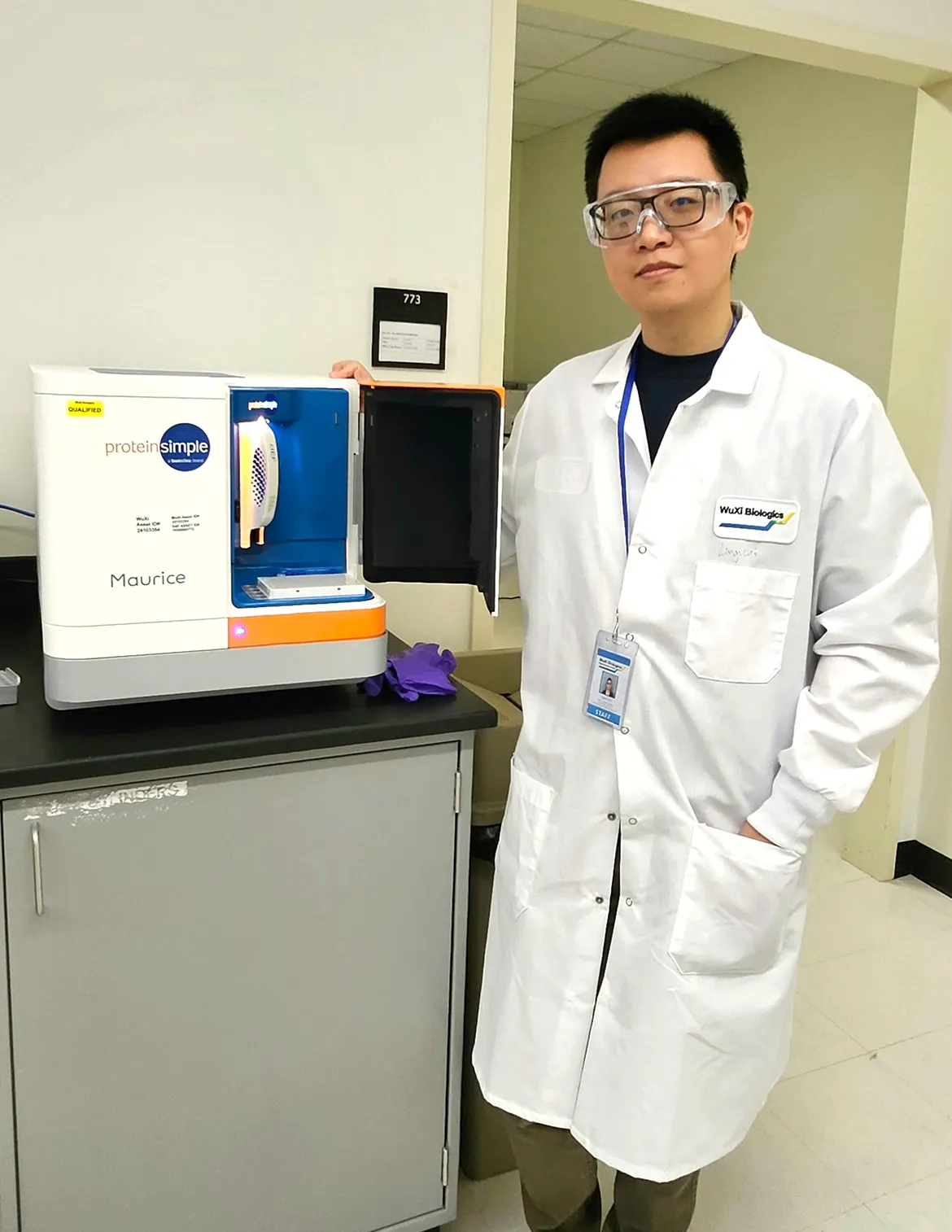
Zhu defended his thesis in August 2022 and now works as a quality-control scientist for WuXi Biologics.
After visualizing vitamin transport across a membrane as a graduate student, Lingwei Zhu has now crossed the biomedical divide from academia to industry
Zhu defended his thesis in August 2022 and now works as a quality-control scientist for WuXi Biologics. He enjoys working in industry and is eager for more of the opportunities for open-ended problem-solving he experienced as a graduate student.
Growing up in New York City, Zhu was strong in biology and enjoyed the subject. So when he arrived at the University at Buffalo as an undergraduate, a biology major felt like a natural fit. He held a couple summer research positions doing polymer synthesis and cell signaling research. “I was very interested in doing research from my undergrad labs,” he recalls.
After graduating, Zhu returned home to New York City to attend Columbia. His original plan was to earn a master’s degree, graduate, and find a job. But then he started purifying proteins in Dr. John F. Hunt’s lab. Hunt “really liked me and thought I was very talented at doing research, and then—bam—I ended up in his lab for the next 6 years,” Zhu says.
He says his dual appointment gave him access to both labs’ resources, and he was able to seek the opinions and advice of two sets of lab members with different backgrounds.
Now on the PhD track, Zhu picked up a project that Hunt had been collaborating on with Dr. Ruben L. Gonzalez Jr. The Gonzalez lab specializes in a technique known as single-molecule fluorescence resonance energy transfer (smFRET), Zhu explains. The technique was useful for studying BtuCD-F, the transporter complex that transports vitamin B12. He took on a joint appointment in the Hunt and Gonzalez labs.
“I would work for a few months in the Hunt lab doing some purification work and doing some ensemble experiments, and then I would move to the Gonzalez lab for another few months doing the single molecule-related studies,” Zhu explains. When he had a new idea or a new finding, he would first stop in the Hunt lab to purify new mutant proteins or work on bulk studies, and then return to the Gonzalez lab to test his ideas. “It was like a circle,” he recalls. “I was migrating between those two labs every few months.” He says his dual appointment gave him access to both labs’ resources, and he was able to seek the opinions and advice of two sets of lab members with different backgrounds.
Zhu’s project focused on using smFRET to visualize the transport of B12 through the transporter BtuCD-F, a type of ATP-binding cassette (ABC) transporter. No one had visualized the transport of a substrate through a transmembrane transporter in real time before, Zhu explains. “I thought, if I could visualize this process using the single-molecule method, it would be a huge breakthrough,” he says.
BtuCD-F comes from a large transporter superfamily known as ATP-binding cassette (ABC) transporters, members of which are found in organisms throughout all six kingdoms. Some ABC transporters may have implications for human diseases such as cystic fibrosis and breast cancer.
“What I was doing was very fundamental,” Zhu explains. “By visualizing the B12 transport, you can study the very fundamental part of the transport mechanism that may be useful in studying other, more significant or more famous transporters in this superfamily.”
The work was slow-going—until it wasn’t. “I was stuck for maybe three years without any big breakthroughs,” he recalls. When he finally visualized the transport, as he recalls it, the solution seemed totally random. One day, he tried a new experiment, and it worked.
“I was very excited,” he says “I was showing the data to everyone in the lab.” Zhu says the observation was so clear that anyone he shared it with understood what had happened. This breakthrough formed the basis of his most recent preprints, which detail the conformational changes that move B12 along the transporter as well as how the substrate-binding protein interacts with the transporter.
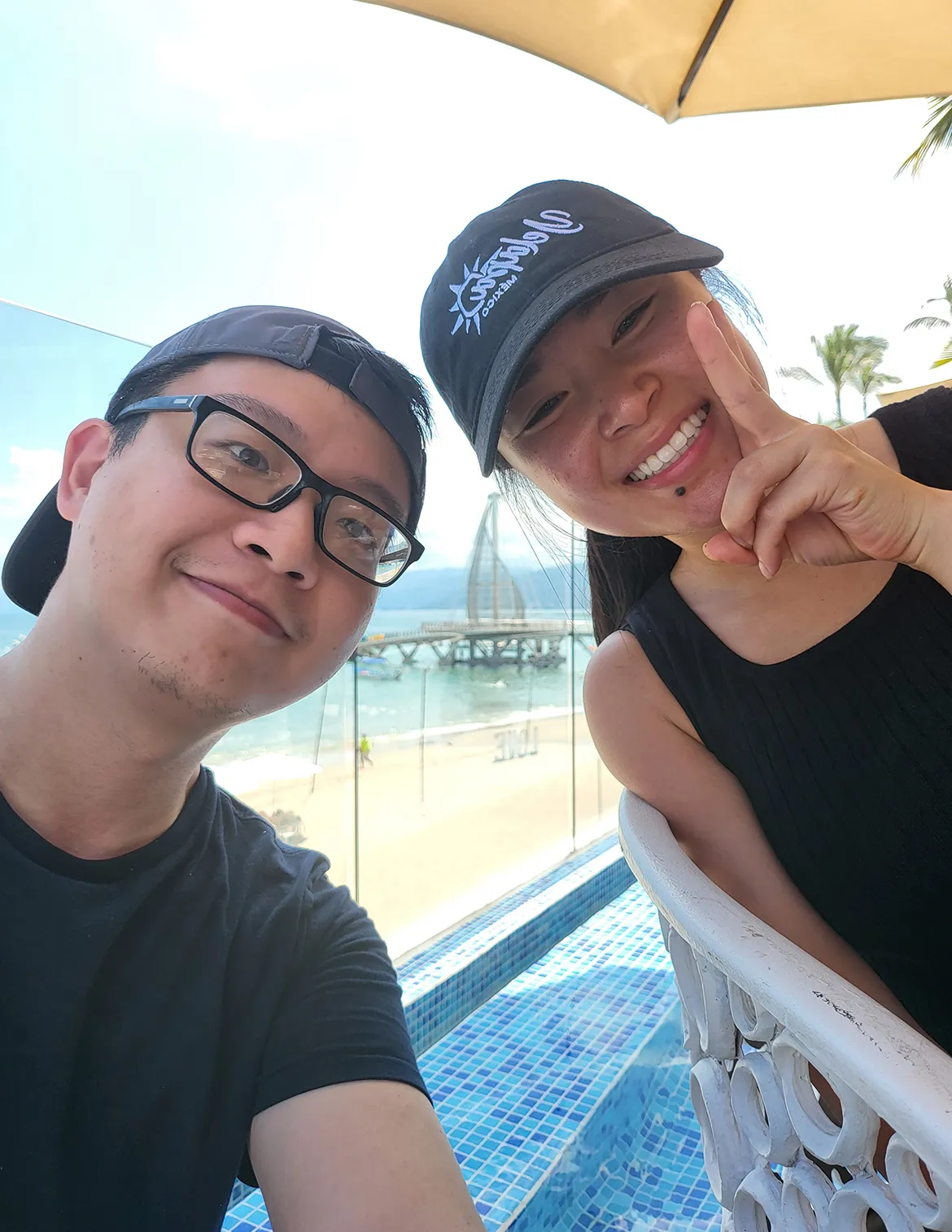
He remembers his time in graduate school fondly. “When my colleagues ask, Where did you come from? I’m always proud to say I was a Columbia student.”
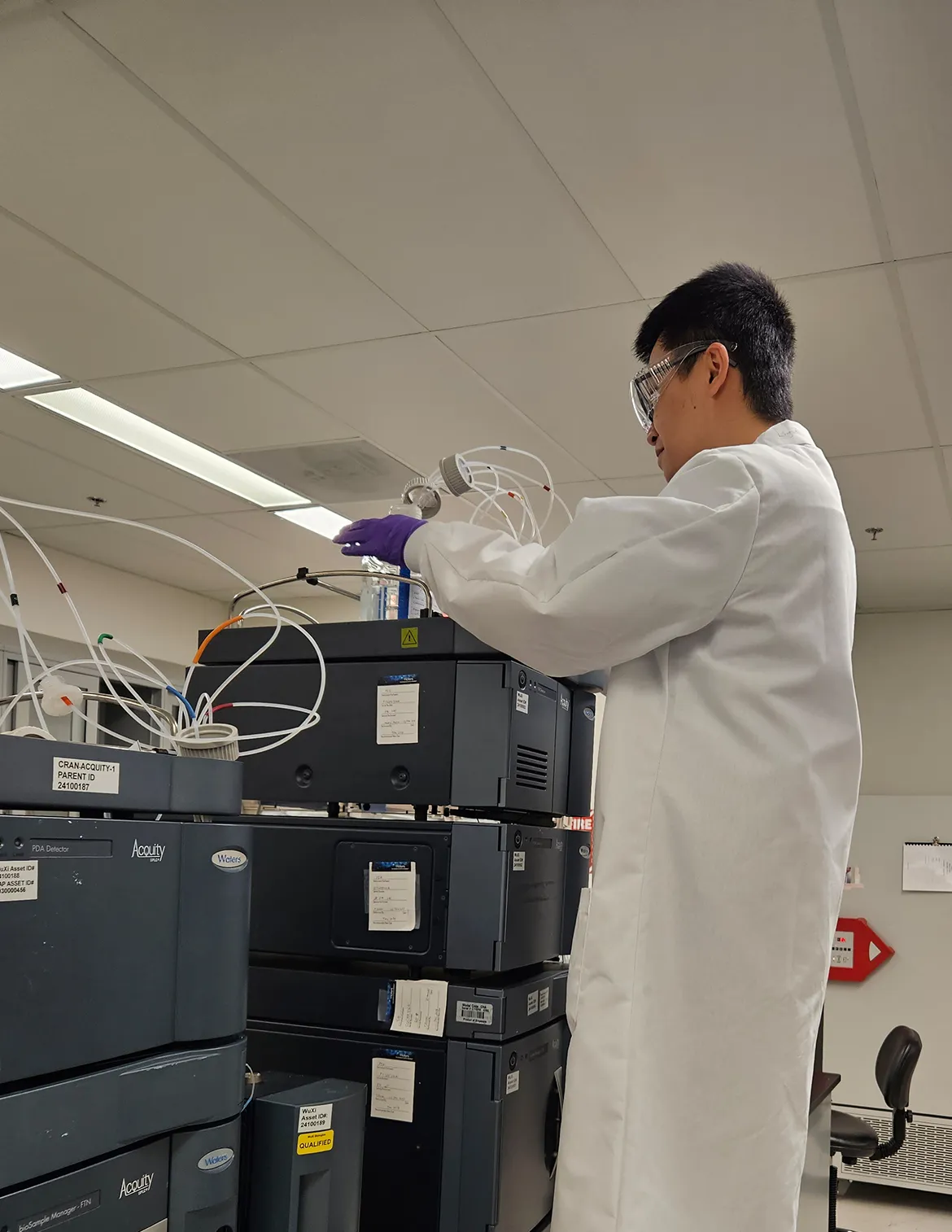
Since graduating, Zhu has taken a role as an analytical scientist at WuXi Biologics, where he identifies and assesses the quality of antibodies, “along with a huge amount of paperwork.” He says his knowledge of proteins from his graduate work have helped him in his new role, and he’s expanding his skill set by learning new techniques.
Zhu says he finds the clear directives of industry fulfilling. In his new job, he takes every opportunity he can to solve open-ended problems. He hopes to one day move into an R&D position, which will allow him more such opportunities.
Reflecting on his time at Columbia, Zhu says he benefited from the mentorship of his two principal investigators. Hunt and Gonzalez “always gave me very good advice—not only in science, but also in life in general.”
He remembers his time in graduate school fondly. “When my colleagues ask, Where did you come from? I’m always proud to say I was a Columbia student.”
BY Alexandra A. Taylor