
Propelled by the faith of her mentors, Succi mapped a neural pathway for pleasurable touch
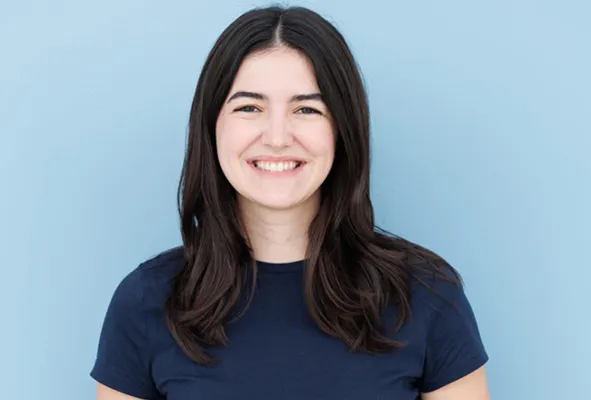
“The idea of being at a bench and getting to ask my own research questions in a lab that’s dedicated to those questions is so exciting. And the dynamic of the lab setting—the closeness, the teamwork, and the collaboration—is so special.”
Isabella Succi helped to trace neurons for pleasurable touch from the skin to the brain before a medical diagnosis made her work personal. In light of that diagnosis, “for me to help understand what happens when something that’s supposed to be pleasurable becomes painful became really important,” Succi says.
Now a third-year PhD candidate in Dr. Ishmail Abdus-Saboor’s lab, Succi is expanding on this work by exploring how context modulates the perception of pleasurable touch and is finding fulfillment in mentoring the next generation of undergraduates.
Growing up in Bucks County, Pennsylvania, Succi competed as a show jumper and spent hours outdoors with her siblings. “Any time I wasn’t in school, we were outside,” Succi recalls. She discovered a love of tinkering when her mother returned to school to pursue a bachelor’s degree in biomedical engineering while her kids were young. Succi and her siblings would quiz their mom with flashcards and even help her solder circuits for medical devices.
As an undergrad at St. Joseph’s University—at the time, a small, primarily undergraduate institution—Succi worked in Dr. Jennifer Tudor’s lab studying how sleep deprivation negatively impacts memory consolidation in mice. As a college freshman, she helped Tudor build her laboratory from the ground up. “We had no mice when we started. We had nothing but some bench space and stuff she brought with her,” Succi says. Over four years, Succi managed the lab, cared for the animals, and coordinated and ran trainings for other students.
Tudor encouraged Succi to pursue a PhD so she could continue with research. During her junior year, Abdus-Saboor—then a biologist at the University of Pennsylvania—visited St. Joseph’s, and Succi gave him a tour of their mouse lab. Succi mentioned that she was looking for an internship, and he invited her to visit him at Penn. She thought he was just being friendly, until her adviser told her the following week, “He wasn’t joking. Email him.”
"I've had really wonderful experiences mentoring and teaching. That has given me a very clear idea of what I would like to do with my life.”
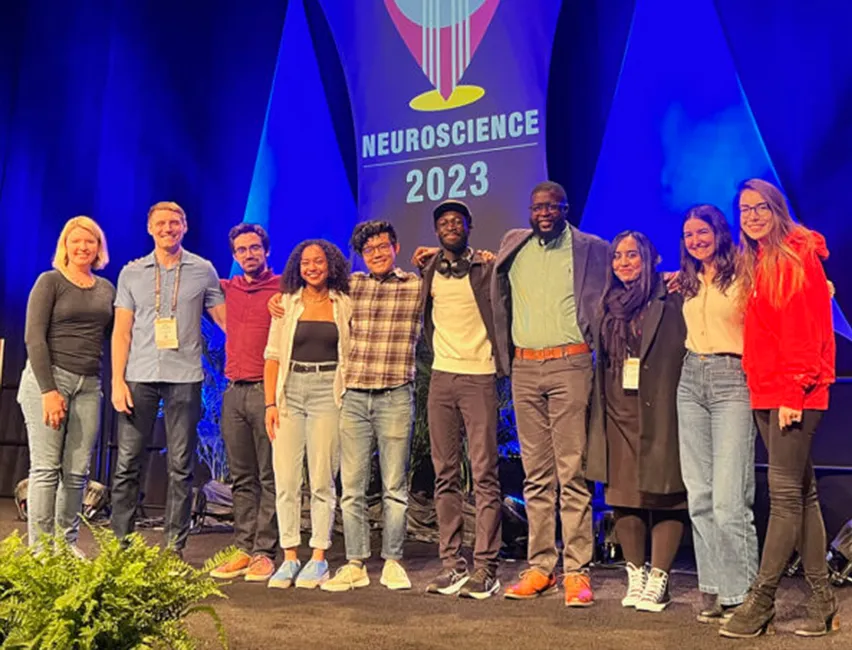
Abdus-Saboor followed through on his offer, and Succi was amazed at what she saw. “At St. Joe’s, our mouse facility was quite literally a closet. I went to Penn, and my mind was blown,” she says. “There was a whole facility and staff and hundreds of researchers.”
She interned at Penn for a summer, and after she graduated, Abdus-Saboor offered her a job as a lab tech. She worked at Penn for nine months before he announced the lab would move to the Columbia University Department of Biology. Succi helped pack up and move the lab and worked in it for nearly a year before starting graduate school at Columbia.
Despite her familiarity with Abdus-Saboor’s lab, when it came time to choose an adviser, Succi still opted to rotate. “I wanted to give myself a really hard choice,” Succi says. She did stints in Dr. Erin Barnhart’s and Dr. Maria Tosches’ labs, trying out different model organisms and techniques before settling back when she had started. “The questions I wanted to ask about biology were ultimately suited for Ishmail’s lab,” she explains.
Succi’s portion of the lab studies social and pleasurable touch. The group has identified a neuron in the skin that, when activated, stimulates the release of dopamine in the brain, indicating a pleasurable sensation that female mice love. But when researchers genetically delete those neurons, the mice lose their drive to reproduce: rather than being receptive to sex, they become combative. The lab’s first paper—which shares this finding and starts to trace the pathway for pleasurable touch from the skin to the brain in mice for the first time—was published in Cell in February 2023.
Succi is proud that the lab was able to publish this work at a time when it was moving and rapidly expanding. Her mentor Leah Elias had started the experiments at Penn, and Succi conducted the revision experiments at Columbia. For Succi, who had watched Elias toil away, tackle hard questions, and navigate roadblocks, being trusted to wrap up the research made her feel that the work had come full circle.
Not long after the paper was published, a medical diagnosis deepened her personal connection to her work. “I have lupus and fibromyalgia. Sometimes a touch that’s supposed to be pleasurable is actually painful or lingers,” Succi explains. “It almost felt like foreshadowing to be in a lab that studies pleasurable touch and pain and then to have a pain disorder later on.”
She’s learning to prioritize self-care. Growing up caring for horses engendered a sturdy work ethic, and she draws on that experience while caring for animals in the lab. “If you’re in charge of any life, it’s a huge responsibility,” she says. Whether you’re sick, you’re not in the mood, or you want to go to a party, “you still have to find a way to make sure that animals’ needs are met.”
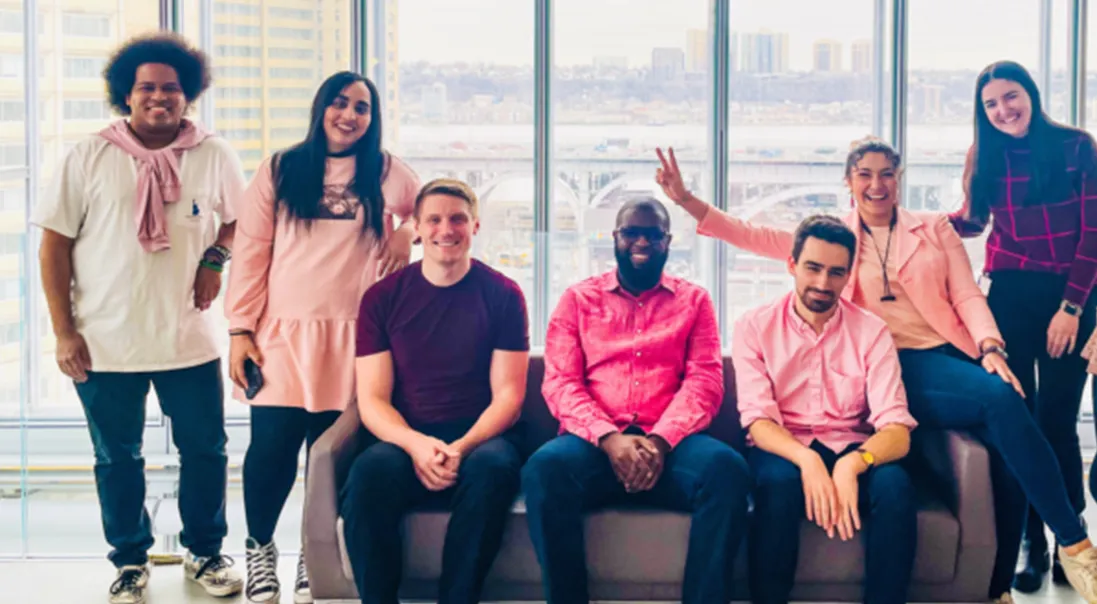
Succi believes she’s found her place in academia. “The idea of being at a bench and getting to ask my own research questions in a lab that’s dedicated to those questions is so exciting. And the dynamic of the lab setting—the closeness, the teamwork, and the collaboration—is so special.”
Succi had drawn confidence from the trust that Abdus-Saboor, Elias, and other mentors placed in her when she was starting out. They treated her as a valued scientist and even allowed her to take on responsibilities of a graduate student when she was a technician. That trust “was so unwavering and made me believe that I could do anything,” Succi says. “That’s part of why I’m having a good time at my PhD: because I know that the support is there for me to finish.”
By Alexandra A. Taylor