
This computational and cognitive scientist combines his love for math with the messiness of biology.
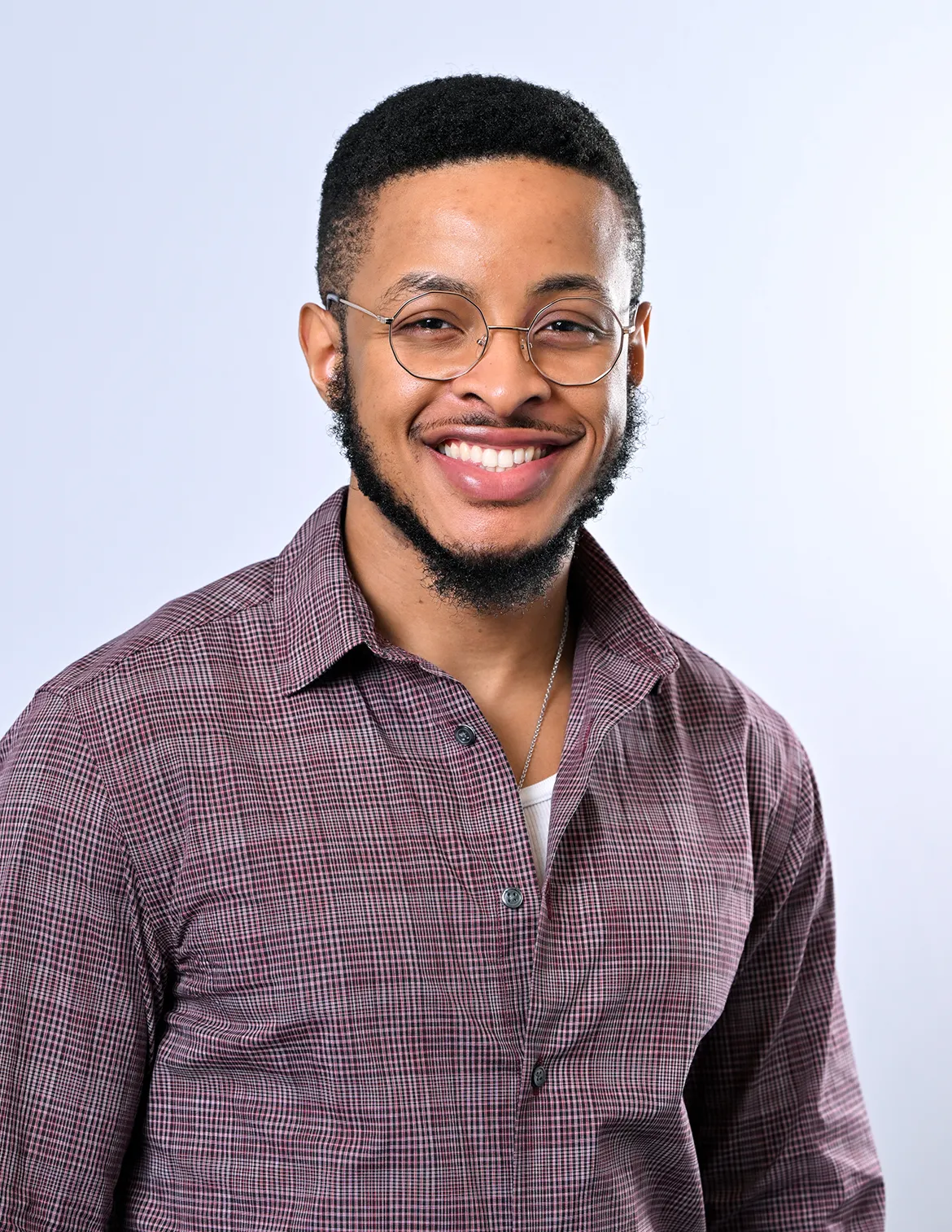
“There is no Standard Model of biology. Anything that possibly could happen in biology probably does happen.”
Growing up in the Greater Toronto Area, Aniekan Umoren was initially interested in physics. “I thought it was really cool how you could write a couple equations and predict the future,” he recalls.
As he started to learn about cognitive science, though, he was drawn in by the complexity and messiness of biology. “There is no Standard Model of biology,” Umoren says. “Anything that possibly could happen in biology probably does happen.”
Now a third year PhD candidate in Dr. Raju Tomer’s lab, Umoren analyzes complex patterns of activity in mouse hippocampal cells, with an eye toward leveraging neurons’ innate plasticity to manipulate these patterns.
Of his elementary school days, Umoren recalls, “I loved it when they would wheel out the big TV and put on Bill Nye on VHS tape. I really liked how they answered these super interesting questions I had about the way things work.”
Upon entering high school, Umoren became interested first in computer science and then neuroscience. He wondered, “What if we could understand the brain better and use the algorithms there to come up with better AI algorithms?” When he arrived at the Massachusetts Institute of Technology as an undergraduate, he chose a brand-new major titled “Computation and Cognition,” which allowed him to combine his interests.
At MIT, he conducted research under Dr. Diego Mendoza-Halliday. “We were looking at how different parts of the brain talk together to facilitate some aspect of cognition—specifically, attention,” he explains. A concentration in philosophy also helped him to understand his assumptions about the mind and ask better questions.
In addition to finding the project exciting, he meshed well with the PI: Umoren values the freedom Tomer gives him to work independently, but at the same time, “I appreciate when he’ll reign me in because I do like to explore and play around with things,” he says.
When it came time to choose a lab as a graduate student in the Columbia University Department of Biology, he was drawn to the Tomer lab. “They had so much data of this cool model system of the brain,” he recalls. “The project seemed ripe for some sort of analysis.”
The lab cultures neurons from the mouse hippocampus so that they form a long-range 3-D network of neurons, yielding an in vitro model of the brain. Umoren says that while the network exhibits interesting patterns of activity, “there had yet to be an attempt to quantify these different patterns of activity, how they respond to stimuli and to different pharmacological interventions,” he says. “It was free real estate for me to come in and start playing around with that.”
In addition to finding the project exciting, he meshed well with the PI: Umoren values the freedom Tomer gives him to work independently, but at the same time, “I appreciate when he’ll reign me in because I do like to explore and play around with things,” he says.

Cheng Gong, a fellow PhD student in Tomer’s lab, has created a microscopy system that stimulates the network with high fidelity and spatial precision using lasers. For a recent co-first authorship preprint posted on bioRxiv (currently undergoing peer-riview), Umoren created a robust analysis pipeline to detect phenomena called intrinsic network assemblies, or groups of neurons that activate together. Such assemblies will sometimes also link together in a behavior known as hierarchical chaining and show pattern completion capabilities which underpin cognitive functions of brain such as learning and memory recall.
“We showed is that these properties are present in our in vitro set-up, which gives us a simpler playground to understand what these properties can be used for,” Umoren explains.
Gong also administers ketamine, a drug chosen for it promise as an antidepressant, to the cells. “In our set-up, we see that the kinds of activity that exist naturally in the network sort of become dissociated—they break apart into smaller sub-patterns,” Umoren says. Exactly what this activity means, and how it relates to the feelings of dissociation is the drug produces, is an open question.
Umoren is proud of the work he put into passing his qualifying exam and credits the support he received from the department’s writing instructor, Meehan Crist, in helping him to flesh out his ideas. “Some people come here knowing exactly what they want to do,” he says. “I had a broad strokes idea that I wanted to do circuit level neuroscience, but by the time I settled into the Tomer lab, I needed to do a lot of reading to come up with a compelling project. I am incredibly grateful to Meehan for the guidance, feedback, and encouragement that helped me to form these connections.”
Outside the lab, Umoren takes Afro dance classes at the Broadway Dance Center, a welcome change from his analytical, data-centric day-to-day. “Instead of trying to analyze something, you just sort of feel it,” he says. “It’s a different kind of thinking.” He’s also a regular visitor to the Riverside Park Traveling Rings, a site for outdoor recreation.
With a fellow graduate student, Umoren organizes a biweekly social hour for the department. “We’ll order food; we’ll order drinks,” he says. “We’ll either have a videogame going, or we’ll bring a lot of board or card games for people to play at their own pace.” Since everyone in the department has different schedules, it’s a nice opportunity to get everyone together.
“I am incredibly grateful to Meehan [Crist, the department's Writer-in-Residence] for the guidance, feedback, and encouragement that helped me to form these connections.”
Umoren has also mentored a high school student and an undergraduate on two different neuroscience projects. Mentoring “gives me another avenue to deepen my understanding—because if you can’t explain it, you don’t understand it,” he says.
Mentoring has also helped Umoren to develop his own pedagogical style as he mulls staying in academia post-graduation. “I can't imagine not waking up every day and just being excited about a question you want to answer,” he says.
By Alexandra A. Taylor