
"It’s good sometimes to work somewhere else, see a different environment. That was what drew me to say, OK, I'm going to take a couple of years and try something new."
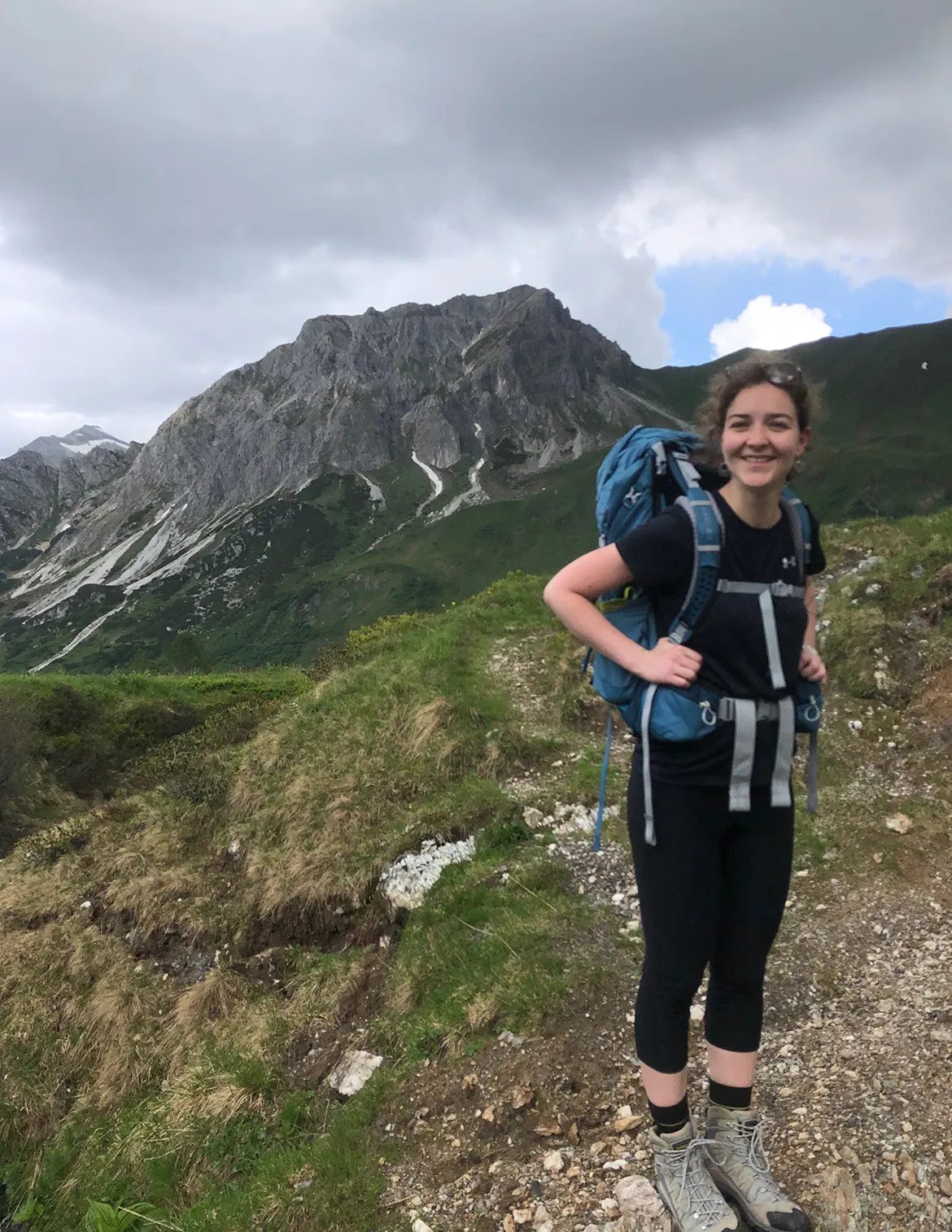
While studying RNA regulation, Street learned how collaboration can benefit science.
Where did you grow up, and where did you get your first research opportunity?
I grew up right outside of New York City, and I was exposed to science pretty early. I was lucky that as a high school student, there was a science research class, and the teacher had made connections with other scientists who have labs around New York. She would contact them every year and say, “Would you have space for a high school student?” And then she would match us up. I'm very grateful that that was something that I was able to do.
The first project was in cancer biology at Mount Sinai School of Medicine. And it was to see if we could label T-cells and monocytes that were harvested from human blood with paramagnetic compounds, and then visualize the cells by MRI. And then the second one was more basic chromatin biology, to understand how DNA methylation is deposited to maintain and regain stemness in iPSCs. And that was the one in Dr. Mitchell Cairo’s lab at Columbia University.
And then you came to Columbia for undergrad. What was your undergrad research like?
I sort of fell into Dr. John Hunt's lab, and I found myself doing a little bit more protein structural work. And that was very different, but also very fun. I mostly helped on a project seeing if you can engineer epitopes, especially to build additional disulfide bridges, to stabilize structures of proteins. It was really nice to spend my summers there and to see something that was a little bit more hardcore protein work. And learning from John was great.
What pulled you to New York University for your master’s degree?
It’s good sometimes to work somewhere else, see a different environment. That was what drew me to say, OK, I'm going to take a couple of years and try something new.
Dr. Sevinc Ercan’s lab, where I ended up, is a great example of the "omics" application of science, which I was really interested in. She’s using lots of different sequencing techniques and trying to see, OK, how can we then correlate all of these results? How can we gain insight into the actual biology from these different types of "omics" data sets?
I had left the pre-med route open in case I decided I wanted to become a doctor. The first year of grad school, I realized how much I really love biology and doing it in the lab. The biology just grabbed onto me and held me, and I couldn't get out. From there, a PhD was the logical thing to pursue after a master's.
"Learning how to do that well—making sure that you are working together, learning how to foster those interpersonal relationships—it really can benefit the science. It went beyond 'I learned how to do this technique,' or 'I learned how to deal with this type of data,' that I think you will get anywhere when you do a PhD."
Then you returned to Columbia and joined Dr. Marko Jovanovic’s lab. What did you find interesting about that research?
In my master's, I was doing both experimental and computational biology in transcription regulation and chromatin regulation in the model system C. elegans. Marko’s work was basically taking that into human cells; broadening it to also do proteomics, which I hadn't done before, as well as transcriptomics; and then also to focus on post-transcriptional regulation and translation regulation. That was nice because I could basically go one step further in the central dogma of biology, and instead of doing DNA-to-RNA, do more RNA-to-protein, and focus on that type of regulation, but still doing it in the basic biology approach that I liked a lot.
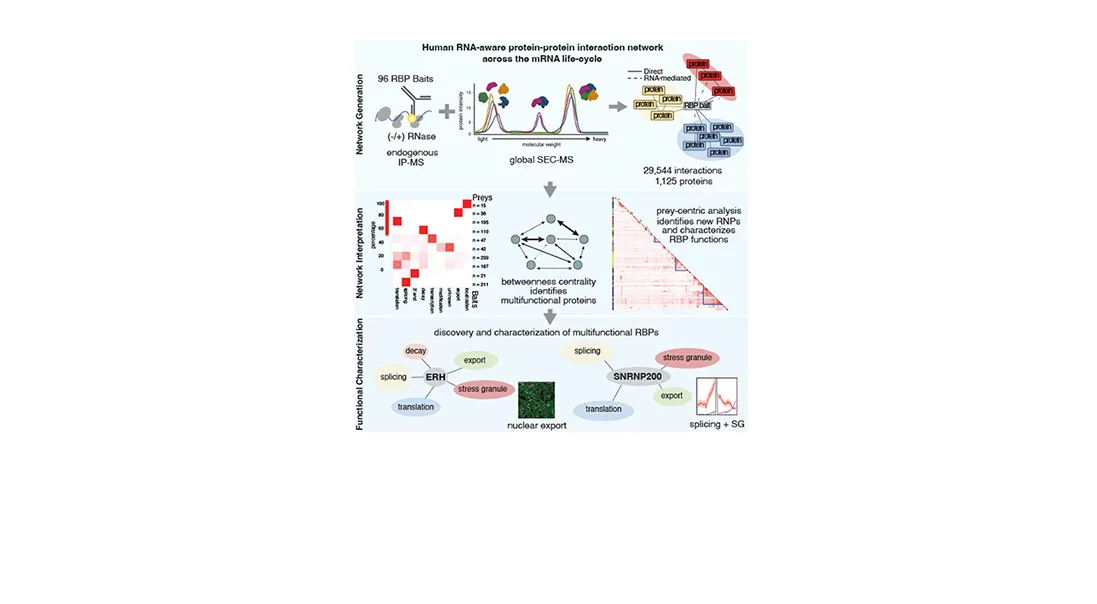
Could you walk me through your recent Molecular Cell paper?
A lot of research in the last 10–15 years has been done to understand which RNAs proteins bind and where on the RNA they bind. But a lot less work has been done to understand the function of those proteins once they're actually binding.
And so we said, OK, if we can map the protein-protein interactions—basically, see which proteins are working together—then we can get a much better understanding of the functional network of these RNA-binding proteins (RBPs) in the cell.
Then we took our two most-connected proteins in the network that we had generated by doing the proteomics work, and we said, OK, let's look into these proteins more. And so we studied them further, and we showed that we could find new functions for those proteins that hadn't been described before and show that they were important for regulation throughout theRNA life cycle.
What was your day-to-day work like while you were working on this paper?
That paper was in collaboration with Dr. Gene Yeo’s lab at the University of California, San Diego. Since we have a mass spec here, I was mostly doing the proteomics, and then the network-scale analysis, and I spent a lot of time figuring out answers to key methodological questions. What is the best way to actually measure the samples? What is the best way to get rid of noise in our data set? It was basically my job to come up with the final network in the sense of, this is what we trust from the proteomics data.
Our collaborators come from a very strong understanding and background of looking at individual RBPs and their functions. So, they did a little bit more of the initial work of going in and saying, OK, what RBPs are now doing something super weird that we haven't seen described before? And could we start doing some follow-up experiments to see if what we're seeing here in this network is real?
It was a good collaboration. It was very even, and everyone could bring the expertise that they had and the resources from the labs. Hopefully people use it and will find it as a useful resource.
When you look back at your time at Columbia so far, what are you most proud of?
The thing I learned most in my PhD was to do more collaborative science. It wasn't necessarily easy at the beginning. In high school or undergrad, you're helping someone to do their science. And then in my master's, I had my project that was my responsibility, and I had to push it over the line and write the paper.
In the Jovanovic lab, the science is more collaborative. That's Marko's approach. Learning how to do that well—making sure that you are working together, learning how to foster those interpersonal relationships—it really can benefit the science. It went beyond “I learned how to do this technique,” or “I learned how to deal with this type of data,” that I think you will get anywhere when you do a PhD.
What’s next after you wrap up your PhD?
I am still the biology student who loves basic biology and academia and wants to stay in basic science. So I'm going to do an academic postdoc, and then I'm going to try my best to see if I can get some type of PI position someday, somewhere. My goal for now is to lead my own lab, so I'm going to keep going that way and see how far I can get.
By Alexandra A. Taylor