
"I was at the intersection of chemistry and biology, and I was looking around for umbrella programs. And that's why I ended up at Columbia: I really loved how interdisciplinary our department is."
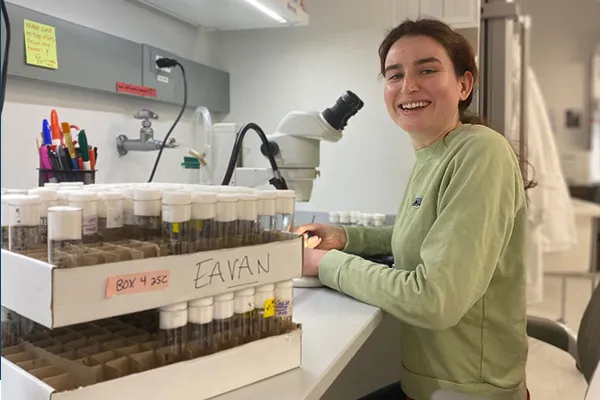
Donovan studies mitochondrial dynamics in fruit flies and helps bring new technologies to market.
Where did you grow up, and when did you first become interested in science?
I grew up in Naples, Florida, and I did a lot of marine biology camps. We would go to the beach, throw a net out into the ocean, and get a plethora of whatever was swimming around in the Gulf of Mexico that day. I really enjoyed marine biology and being able to look at a scoop of water underneath a microscope and see all these bacteria, microbes, plankton. And that got me interested and thinking more about what's beyond what you can see in the world—that there are such small building blocks to the life all around us.
Tell me about your research experiences as an undergrad.
I went to a small liberal arts college in Minnesota called Carleton College, which emphasizes interdisciplinary studies. Throughout undergrad, I did lots of different summer internships and went to different universities. I was lucky to be able to study across academic institutions. I did an internship at University of Utah focused on viruses and HIV, and then I went on to study cochlear deficiencies and hearing loss in neonatal mice at Charité – Berlin University Medicine and was then able to do a little bit of nuclear magnetic resonance at the Leibniz Institute for Molecular Pharmacology.
The research experiences in Germany I self-created. I connected with a Carleton alumnus who was doing a postdoc in Germany, and I ended up creating a space for myself by getting funding from Carleton and going there for a summer. Then I was able to do study abroad and have an internship after. Germany has a lot of great research opportunities, and I was able to experience everything from a clinical setting all the way to basic science.
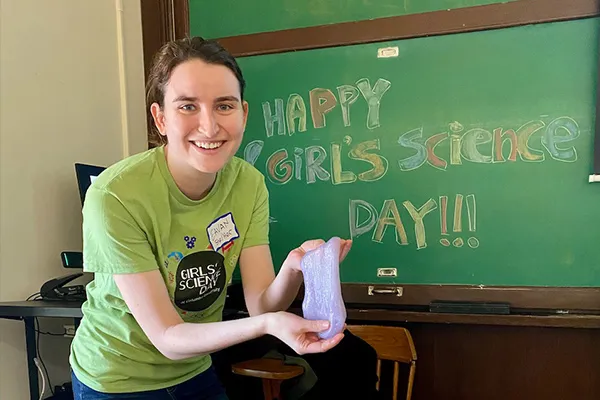
For me, being a mentor and a collaborator is the most fulfilling part of the job, besides doing the science I love. Whether it be undergrads, rotation students, or technicians, the people make the job enjoyable and fulfilling.
"For me, being a mentor and a collaborator is the most fulfilling part of the job, besides doing the science I love."
What made the Columbia University Department of Biology and Dr. Erin L. Barnhart’s lab the best fit for grad school?
I knew I really loved doing science and wanted to do a PhD program. I was at the intersection of chemistry and biology, and I was looking around for umbrella programs. And that's why I ended up at Columbia: I really loved how interdisciplinary our department is.
Erin was a newly joined faculty in the department, and her work focuses on the distribution and transport of mitochondria and other organelles throughout the cell. I was enamored with her work, and I wanted to learn a lot more about it.
My project is all about mitochondrial transport and neurons. Once I was doing the experiments, I just fell in love with the day-to-day aspects of it. I find it really challenging, which is something I really enjoy. And I also really enjoy the mentorship style of my PI. I really am quite happy with how my thesis has progressed so far.
Could you talk a little bit more about your day-to-day work?
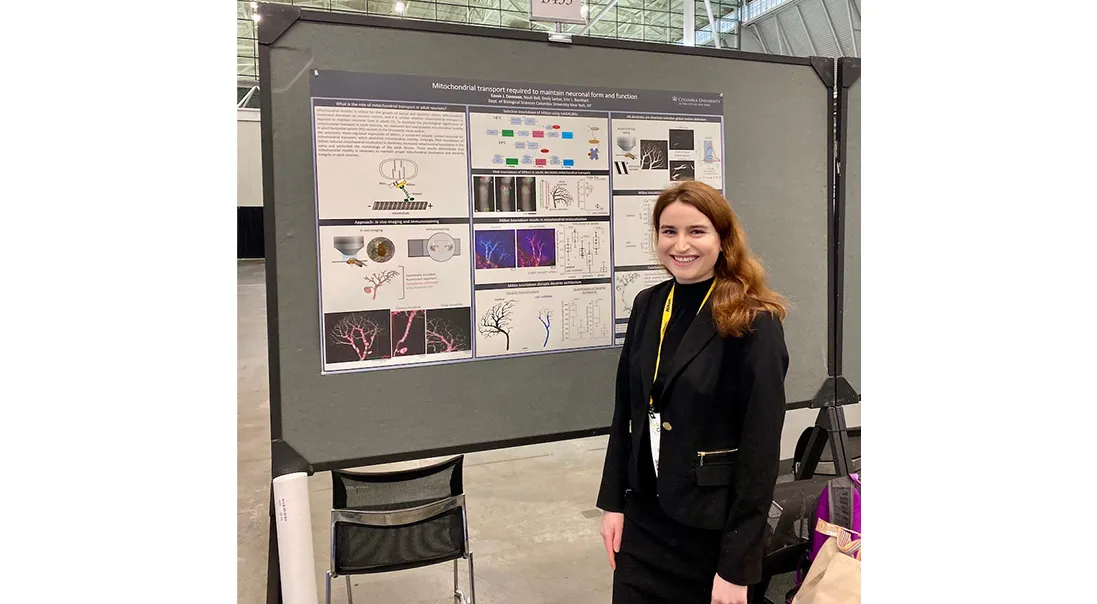
Right now, I'm writing up a manuscript focused on my work on mitochondrial transport in horizontal system neurons in the Drosophila visual system. Specifically, I want to understand the role that transport plays in maintaining a neuron.
I perturb mitochondrial transport by knocking down an essential adapter protein for transport along microtubules, which then alters mitochondrial localization throughout the neuron. And then I use functional reporters to assess how that affects the function of the neuron- whether the neuron can create ATP, buffer calcium, and connect with other neurons.
The goal of our work is to really understand the basic biology behind mitochondrial localization and transport, and to understand how organelle transport affects neuronal biology as a whole.
Day to day, I take care of my fruit flies. I do dissections on live fruit flies. And I do lots of analyses, trying to figure out, for example, how we can analyze an image in the most efficient way possible.
Could you walk me through a summary of your recent Cell Reports paper?
This paper, which was the lab’s first paper, emerged out of COVID. We were stuck outside the lab for a good amount of time. We wanted to address some questions working remotely, so we teamed up with Dr. Elena Koslover’s lab at the University of California San Diego.
Our basic highlight of this paper was to generate a model in dendrites to predict localization patterns of mitochondria. We wanted to find if there were rules that we could define to recapitulate the localization patterns and transport patterns that we see in vivo.
To do this, we capitalized on a data set that was already being traced. In this data set, we reconstructed mitochondria throughout various neurons. Once we found the distribution and density of mitochondria, then we use mathematical modeling to identify the minimum number of rules that would get us to the observed distribution of mitochondria across the cell. We arrived at four rules of scaling, which helped us to understand how mitochondria are localized in one cell type.
I understand you are a Columbia Technology Ventures fellow. Could you talk a little bit about that experience?
The Technology Ventures Program is for all of Columbia. Any PI, grad student, or postdoc who generates, say, a new form of cement—something that could potentially be put on the market—goes through the office to help develop a product and market it to outside industry.
One of the key parts of the program is you're not just dealing with technologies in biology, but across multiple departments. I really love the ability to learn about technologies and new innovations that come out of, say, dentistry or electrical engineering—fields I wouldn't normally interact with in my own PhD.
Coming into Columbia, I wasn't sure what I wanted to do career-wise, but I wanted to explore all of the options. Right now, I'm in the sixth year of my PhD, hoping to defend in the spring. Moving on from that, I hope to move on to do patent law or business development. The office and the fellowship have been great in developing my skill set and connecting me with different faculty and people in the CTV office to support me.
When you look back at your time at Columbia so far, what are you most proud of?
Being a mentor has been a fantastic use of my time. Having undergrads who come into lab thinking about one career trajectory, unsure of themselves, not very confident in their skill set, and then come out of the lab, go into a science career and feel really confident in their abilities and in their motivation has been really fulfilling. I've gotten the pleasure to work with several undergrads.
BY Alexandra A. Taylor